

Identium provides RFID for automotive plants — paint shop and welding, cockpit, chassis and assembly line automation. Our RFID solutions track skids, auto-guide cars and conveyors so the production management system always knows which body is at which station. Identium hardware is proven at scale in India, with deployments for marquee manufacturers including Suzuki.

Where RFID fits in automotive manufacturing
- Paint shop and weld shop — skid and carrier identification through the harshest stages of the line
- Cockpit, chassis and trim — assembly line automation with event-triggered data at every station
- Conveyors and auto-guide cars — automatic routing decisions driven by RFID reads
- Vehicle identification — UHF windshield tags track vehicles in assembly lines, dispatch yards and at toll gates
- Mandatory labelling — compliant identification across assembly lines, warehouses and stores
- Workshop and maintenance management — service history tied to each vehicle and tool
- Dealer, distributor and loyalty programmes — managed with RFID cards
Built to talk to your PLCs
Production management servers are populated with event-triggered data through PLCs and industrial bus controllers, and we have the experience to integrate RFID controllers with most PLCs used in the automobile industry. Identium supplies RFID controllers in Serial, RS-485, USB, Industrial Ethernet, TCP/IP, Profibus and DeviceNet — the protocols automotive plants already run on.
Recommended Identium hardware
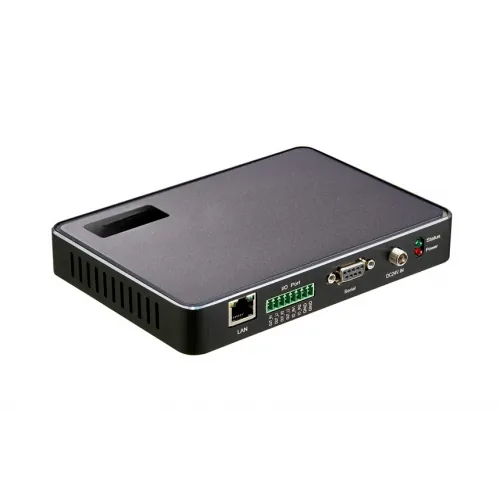
- IHZ4 4-port fixed reader — one controller reading four stations over Ethernet/TCP-IP.
- CR400 ceramic on-metal tag — heat-resistant tag for skids and carriers through paint and weld shops.
- UHF windshield tags — vehicle identification from line-off to dealer dispatch.
- UHF gate reader HLR200 — finished-vehicle and parts movement at plant gates.
- CX1500N handheld RFID reader — yard searches, audits and exception handling.
Related solutions
Tyre plants have their own page — see RFID for tire manufacture. Planning line-side RFID or a dealer programme? Talk to our team and we will map read points station by station.
Choosing the frequency and tag body for a car plant
Almost everything moving through an automotive plant is best read with passive UHF RFID on 865-868 MHz — the licence-exempt band India’s WPC allocates for UHF RFID as of 2026; confirm the current WPC and BIS position before you freeze a specification. UHF suits the job because a station read has to happen while the skid is still moving and without line of sight, typically over anything from under a metre to a few metres depending on antenna, tag and surroundings — and because EPC Gen2, formally ISO/IEC 18000-63 and marketed as RAIN RFID, is the protocol the UHF readers and tags in this band are built around. Identium’s UHF readers and antennas are WPC-approved for India’s licence-exempt UHF RFID band. The one exception is people and paperwork: dealer, visitor and employee cards usually run on HF 13.56 MHz (ISO 14443, Mifare or DESFire), with older site access systems on LF 125 kHz. Neither is EPC Gen2 — they are different technologies and need their own readers.
Read range is where automotive projects often run into trouble, and the fix is usually less power, not more. A weld shop is a room full of reflective steel, so a reader left at full output can read the skid at the next station and log the wrong body. The IHZ4 listed above has RF output adjustable from 0 to 33 dBm in 1 dBm steps, with RSSI reporting and data filtering, so tune each antenna down until the read zone stops at the station boundary, then verify it again with the line actually running. Expect the usable range at your site to differ from any datasheet figure — metal, cabling and neighbouring antennas all move it.
Matching the tag to what it rides on
| What you are tagging | Conditions | Tag to ask for |
|---|---|---|
| Skids, hangers, carriers | Repeated oven and overspray cycles | Sealed on-metal hard tag, riveted or epoxy-potted |
| Engines, castings, gearboxes | Bare metal, oil, tight mounting space | Compact ceramic on-metal tag |
| Returnable bins, dunnage, trolleys | Washdown, transit between suppliers | Rugged off-metal tag, or a cable-tie tag where drilling is not allowed |
| Finished vehicles | Glass, outdoor yard | Adhesive-applied UHF windshield tag |
| Fixtures, torque guns, hand tools | Workshop clutter, very little flat surface | Small on-metal tag |
Two things are worth settling before you order. First, the real peak temperature and dwell time of your e-coat and paint ovens: send us the figure and we will specify a tag body — ceramic, PPS or potted — suited to that profile, rather than assuming a general-purpose tag will survive. Second, whether carrier tags are written once or rewritten every cycle. Reusable skid tags need a chip with read-write user memory and a mounting method — rivet, epoxy potting or ultrasonic weld — that outlasts the paint. Custom tag bodies, encoding, laser marking and serial numbering are done at our New Delhi factory, with custom tags typically running a 5-10 day turnaround, and units are tested in-house before dispatch.