

Fintech · HF/NFC RFID
Tap. Pay. Done.
IDPay is Identium’s RFID cashless payment platform for festivals, stadiums, theme parks, corporate canteens, and closed-loop venues. Guests top up once and tap to pay — no cash, no cards, no queues.
Powerful Features
Built for Scale, Precision & Speed
IDPay is Identium’s RFID cashless payment platform for festivals, stadiums, theme parks, corporate canteens, and closed-loop venues. Here are the capabilities you get with Identium.
RFID Wristband Wallet
Every guest gets an RFID wristband with a digital wallet preloaded or topped up on-site.
Sub-second Transactions
Offline-capable tap reads in ~500ms — queues move 3x faster than card/UPI.
Live Revenue Dashboard
Organisers see sales by stall, hour, and guest segment in real-time.
Auto-Refunds
Unused balance auto-refunded to the original payment method post-event.
PIN-protected Top-ups
Optional PIN for high-value transactions to prevent misuse if wristband is lost.
Loyalty & Promotions
Run targeted promotions — “Happy hour 50% off at Stall 4” pushed to all active wristbands.
Vendor Settlement
Automated daily settlement reports per vendor/stall with GST-compliant invoicing.
Guest Mobile App
Top up, check balance, see spending history, get refunds — all from the guest’s phone.
Offline-resilient
Readers keep working during internet outages — syncs when connection returns.
How It Works
Three-Layer RFID Architecture
A clean flow from tagging to real-time dashboards — built for operational scale.
Top-up wristband
Guests receive an RFID wristband at entry or pre-registration, preloaded with credit.
Tap to pay at stalls
Vendors use handheld or desk readers to deduct amounts — half-a-second per transaction.
Settle & refund
Auto-refunds for unused balance; vendors get settled daily with compliant reports.
Hardware & Tags
Recommended Products
Enterprise-grade UHF/HF RFID hardware, sourced from our sister store IndiaRFIDStore.com.
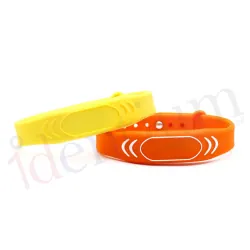
RFID Silicone Wristband
Comfortable silicone RFID wristband for events, attendance, patient ID, and cashless payments.
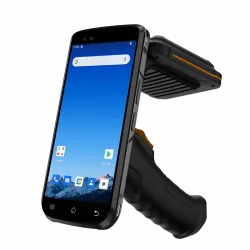
RFID Handheld Reader
Portable UHF scanners with Wi-Fi/BT connectivity for on-the-go asset verification and mobile audits.
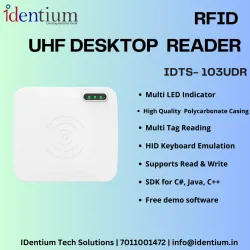
UHF Desktop Reader
Compact desk-mounted reader/writer for encoding tags, issuing cards, and point-of-service scanning.
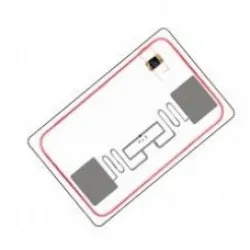
RFID Smart Card
HF / UHF / dual-frequency RFID cards for access, attendance, library, and ID use-cases.
Use Cases
Deployed Across These Industries
Identium is trusted by organisations in manufacturing, retail, healthcare, logistics, events, and the public sector.
Music Festivals · Stadiums · Theme Parks · Food Courts · Corporate Canteens · University Cafés · Camps · Cruises
Cashless your venue?
Let IDPay power frictionless payments at your next event.
Want the full technical deep-dive? Explore IDPay Cashless Payments on Identium One →
Related: Hospitality · Education · Tourism
Choosing the credential and readers for a tap-to-pay venue
Closed-loop payment belongs at HF 13.56 MHz — NFC, under ISO 14443 (Mifare Classic, Ultralight, DESFire, NTAG). The short range is the point: a till must read the one band held to the pad and nothing else, and an ISO 14443 credential typically reads over a few centimetres, so the queue behind stays silent. Some HF readers also handle ISO 15693 vicinity cards, which work at a longer distance — useful for lookups, less so for a payment tap. Passive UHF sits in a different band entirely: 865–868 MHz, India’s delicensed UHF allocation under WPC rules as of 2026, where a fixed reader typically reads several metres depending on tag, antenna and environment — easily enough to pick up half the crowd at a counter. That earns UHF its place at the entry gate for hands-free flow, not at the point of sale. The terms EPC Gen2, ISO/IEC 18000-63 and RAIN RFID belong to that passive-UHF side only — an NFC wallet credential is not a RAIN tag, whatever a spec sheet calls it.
The second decision is where the balance lives, and it drives the chip:
| Wallet model | Suitable chips | Trade-off |
|---|---|---|
| Balance on the server, band carries only a serial | NTAG213, Ultralight, F08 | Simplest, cheapest credential; the till has to cache locally so a dropped link doesn’t stall the queue |
| Balance written on the chip | DESFire EV1 | Can settle a tap with no live link at all; needs real key management, so plan that into the project rather than bolting it on later |
| Low-value closed loop, reusable bands | Mifare Classic S50/1K | Well supported and inexpensive; not the choice where a single band can carry a high stored value |
Reader form factor follows the stall, not the other way round. The HMR65 is a compact plug-and-play HF reader that connects over micro-USB and has no battery to charge, which suits a permanently powered till; the HRP60 portable connects to an Android handset over an OTG cable for a roving vendor; the HRD20 desktop reader reads and writes, so it fits the top-up counter where cards and bands are issued and encoded; the HBWR is a watch-type Bluetooth reader for staff who need both hands free. If the venue also runs 125 kHz staff proximity cards, the read-only DLH20 covers HF and LF in one unit. Supported card families differ by model, so check the datasheet against the chip you have settled on — particularly if you are taking the encrypted, balance-on-chip route. Every reader ships with an SDK, demo app and source code, so the vendor app is built against the hardware rather than around it.
We manufacture the credentials themselves in New Delhi — silicone bands for reusable and multi-day wear, Tyvek and PVC for single-entry — with printing, artwork, serial numbering and encoding done in-house, and units tested before dispatch. Customised orders typically run a five to ten day turnaround.