

Retail · Luxury · UHF RFID
Gold, Diamond, Every Piece Counted.
Jewellery retail demands daily audits, millimetre-level inventory precision, and theft-proof processes. Identium’s RFID Jewellery Management tags each piece with a near-invisible UHF inlay — trays count in seconds, try-on analytics surface, and showroom-to-vault movements are logged.
Built for Scale, Precision & Speed
Jewellery retail demands daily audits, millimetre-level inventory precision, and theft-proof processes. Here are the capabilities you get with Identium.
Display-tray Scanning
Entire tray of 50 pieces read in 8 seconds — daily open/close counts become routine.
Micro Tags
Tiny UHF inlays sealed into price tags or piece packaging — invisible to customers.
Try-on Analytics
Which pieces tried on most? Which lead to sales? Data for buyers and merchandisers.
Showroom-to-vault Flow
Portal reader between showroom and vault logs every movement, by user and time.
POS Integration
Tag matches POS sale — automatic inventory deduction; no manual SKU entry.
Insurance Inventory
Detailed, photo-linked inventory records for insurance valuations.
Staff Accountability
Every piece attributed to a salesperson when on the floor — builds ownership.
Shrinkage Alerts
Piece leaves the showroom without a matching POS sale? Alert the manager.
Auditor-ready Reports
BIS hallmark, 22/18 carat, karatage, weight, and location — exportable for statutory audits.
Three-Layer RFID Architecture
A clean flow from tagging to real-time dashboards — built for operational scale.
Tag every piece
Micro UHF inlays embedded in piece tags or packaging with SKU + weight + karat encoded.
Tray & doorway reads
Countertop tray readers for daily audits, doorway gates between vault and showroom.
POS + analytics
Real-time inventory, try-on data, and sales performance in a single dashboard.
Recommended Products
Enterprise-grade UHF/HF RFID hardware, sourced from our sister store IndiaRFIDStore.com.
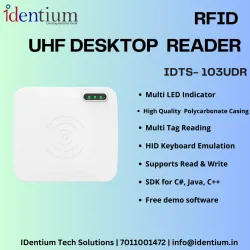
UHF Desktop Reader
Compact desk-mounted reader/writer for encoding tags, issuing cards, and point-of-service scanning.
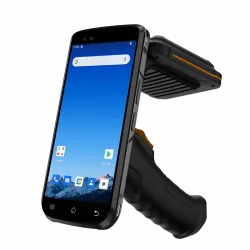
RFID Handheld Reader
Portable UHF scanners with Wi-Fi/BT connectivity for on-the-go asset verification and mobile audits.

UHF RFID Gate Reader
Fixed UHF gate reader for automated entry/exit tracking at warehouse doors and checkpoints.

UHF RFID Label (H10)
High-performance UHF label for non-metallic items — cartons, books, plastic cases, inventory labelling.
Deployed Across These Industries
Identium is trusted by organisations in manufacturing, retail, healthcare, logistics, events, and the public sector.
Jewellery Showrooms · Diamond Traders · Bullion Stores · Luxury Watches · Designer Studios · Jewellery Manufacturers · Museum Collections · Safe Deposit Boxes
Lock down your jewellery inventory.
RFID pilot on one showroom — full chain rollout made simple.
Want the full technical deep-dive? Explore JewelID Jewellery Management on Identium One →
Related: RFID Jewellery Tags · Luxury industry · Perfume industry
Why UHF is the right band, and what gold does to a tag
Jewellery stock control is a bulk-read problem: a whole tray has to answer together, not piece by piece. That is what makes HF 13.56 MHz and NFC a poor fit here — NFC reads one tag at a time held almost against the reader, and while HF vicinity tags (ISO 15693) do support anti-collision, the range stays at centimetre scale, which suits a single counter tap rather than a tray sweep or a doorway. Passive UHF is the practical choice: EPC Gen2, formally ISO/IEC 18000-63 and marketed as RAIN RFID — terms that apply to passive UHF only — is built to singulate many tags in a single pass, so a tray typically reconciles in one go rather than item by item. Indian deployments run on the delicensed 865–868 MHz band under the 2021 WPC short-range-device rules; confirm the current allocation with WPC if your requirement is an unusual one. Identium manufactures these tags in New Delhi, and our UHF readers and antennas are WPC-approved for licence-exempt UHF RFID use in India.
The catch is that gold, silver and platinum are metal. A UHF inlay pressed flat against a solid bangle or a broad kada detunes and loses range, and the fix is placement, not more power: a dumbbell or rat-tail tag holds the inlay off the metal instead of against it. Two habits matter on the floor. Lay a tray out in a single layer rather than nesting rings, because pieces shadow one another. And keep counter reads tight — a desktop reader’s field is deliberately short, which is the point: you want the tray in front of the reader, not the one behind it or the cabinet across the aisle.
| Tag style | Suits | Watch for |
|---|---|---|
| Dumbbell / rat-tail | Rings, chains, small studs | Inlay needs to hang clear of the metal |
| Printed hang-tag | Bangles, sets, display pieces | Bulk on very delicate items |
| Sticker inlay | Boxes, certificates, paperwork | Not for direct contact with metal |
| On-metal hard tag | Safe trays, vault bins, fixtures | Larger footprint; fixed assets rather than stock |
On encoding, let the tag carry a unique serial as the primary key and keep karat, net weight, hallmark and price in the database against that serial. Pieces come back from the karigar repolished, resized or re-set and the weight changes, so make re-tagging and re-verification a defined step rather than an exception. At the vault doorway, tune the gate power down until it stops picking up the nearest display case: a showroom is a small room, and an over-powered portal causes more trouble than a missed read. Every read range here is typical rather than guaranteed — the piece, the tag placement, the metal around it and the reader setup all move it.
Related reading
- RFID in jewellery retail: stock audits and billing — the daily showroom workflow.
- Troubleshooting RFID tags that will not read — detuning, shadowing and read-zone faults.
- RFID retail loss prevention — shrinkage control and exit alerts for high-value stock.