
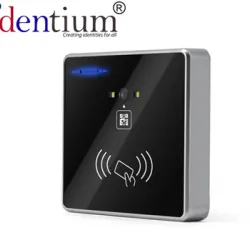
**IDentium HF RFID Mobile Readers **
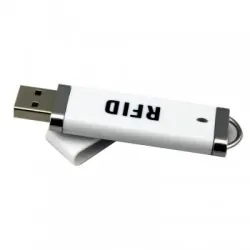
**IDTS – HMR65 **
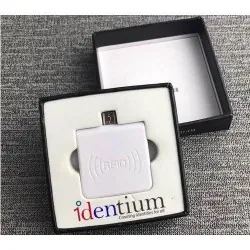
IDentium HF Mobile Reader IDTS – HMR65 is a compact HF Reader working in the 13.56 Frequency Band. It supports all major HF Cards : Mifare 1k, 4k, Ultralight, Mifare 2k.
Features :
- Plug & Play Reader
- Complete SDK and Demo App for Application Development(Android SDK Available)
- Available in Read & Write, Read only models
- Compact Size
- Connects through Micro USB
- Battery less, Charging is not required
IDentium HF Mobile Reader IDTS – HMR65 Datasheet
IDentium HF RFID Readers
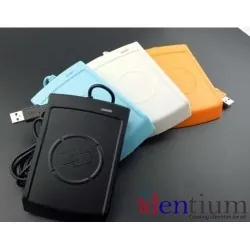
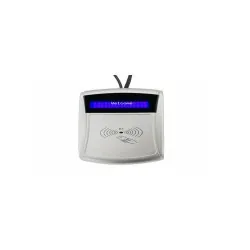
IDTS – HRD20
IDentium HF Reader IDTS – HRD60 is a Desktop based HF Reader working in the 13.56 Frequency Band. It supports all major HF Cards : Mifare 1k, 4k, Ultralight, Mifare 2k.
Features :
- Plug & Play Reader
- Complete SDK and Demo App for Application Development(Android SDK Available)
- Available in Read & Write, Read only models
- Compact Size
- Connects through USB Port
IDentium HF Reader IDTS – HRD20
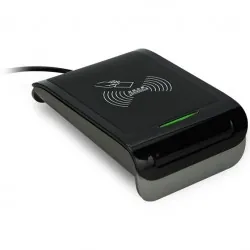
IDentium HF Portable Reader
**IDTS – HRP60 **
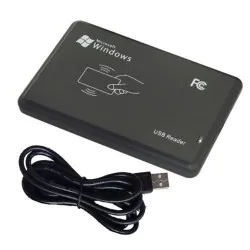
IDentium HF Portable Reader IDTS – HRP60 is a compact HF Reader working in the 13.56 Frequency Band. It supports all major HF Cards : Mifare 1k, 4k, Ultralight, Mifare 2k.
Features :
- Plug & Play Reader
- Complete SDK and Demo App for Application Development(Android SDK Available)
- Available in Read & Write, Read only models
- Compact Size
- Connects through USB Port
- Can be connected to a mobile using OTG cable
IDentium HF Portable Reader IDTS – HRP60
IDentium Dual Frequency RFID Reader (HF + LF)
**IDTS – DLH20 **
IDentium Dual Frequency Reader IDTS – DLH20 is a compact HF Reader working in the 13.56 and 125 KHz Frequency Band. It supports all major HF and Proximity Cards : Mifare 1k, 4k, Ultralight, Mifare 2k, TK4100, EM4200
Features :
- Plug & Play Reader
- Available in Read only
- Compact Size
- Connects through USB
- Can Read both HF & LF Cards and Tags
IDentium Dual Frequency RFID Reader(HF + LF) IDTS – Dlh20 Datasheet
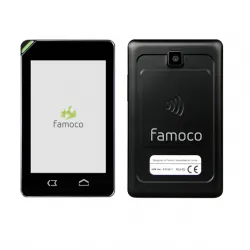
IDentium HF Bluetooth Reader
IDTS – HBWR
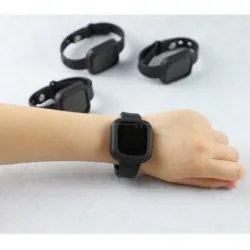
IIDentium HF RFID Bluetooth Reader is a Watch Type Bluetooth RFID Reader
THe Reader is capable of Reading multiple protocols including RFID 14443A(Mifare 1k, desfire), ISO15693(ICODE Slix) & ntag21x
The Reader works in low power mode with auto sleep function with a working time of up to 8 hrs.
Features :
- Complete SDK and Demo App for Application Development(Android SDK Available)
- Compact Size
- Connects through Bluetooth
- Inbuilt Battery, Micro USB for charging
- Can also be removed from the strap and used as a keychain or locket
How to specify an HF RFID reader
All five units read HF at 13.56 MHz, and the DLH20 adds a 125 kHz LF side. HF couples inductively in the near field, so the usable distance is typically a few centimetres and the credential has to be presented deliberately — the right behaviour for card access, attendance, canteen and locker taps, library circulation and enrolment desks. Chips under ISO 14443 and ISO 15693 also carry addressable memory, and on the Mifare and DESFire families that memory sits behind keys held on the card itself.
One terminology trap is worth settling before a tender goes out. EPC Gen2, ISO/IEC 18000-63 and RAIN RFID all describe passive UHF only — the band India delicensed for it is 865-868 MHz under G.S.R. 853(E) of 10 December 2021, made in supersession of the 2005 rules that set 865-867 MHz, and allocations are revised, so confirm the current position with WPC. None of it applies to 13.56 MHz hardware, which makes “Gen2 compliant” in an HF reader specification a drafting error rather than a requirement. Equally, the DLH20’s 125 kHz side is proximity-card LF (TK4100, EM4200); it is not the 134.2 kHz FDX-B animal standard under ISO 11784/11785, and these units will not read that.
Settle these two before you order
| Decision | Why it bites later |
|---|---|
| Read-only or read-write | Issuing a credential, rewriting a stored value or setting a library security bit needs write capability. The HMR65, HRD20 and HRP60 are listed in both read-write and read-only models; the DLH20 is read-only, so it reads a legacy estate but cannot re-issue it. Ask us to confirm which model the Bluetooth HBWR ships as for your order. |
| Which standard, not just “Mifare” | The published card lists differ by unit. The HMR65, HRD20, HRP60 and DLH20 name the Mifare families (1K, 4K, 2K, Ultralight); ISO 15693 tags such as ICODE SLIX, and NTAG21x, are listed on the HBWR. Library and some asset tags are ISO 15693 rather than ISO 14443, so send the chip part number and we will confirm the unit against that, not against the family name. |
Tap distance depends on the credential and the mounting
The usable tap depends more on the credential’s antenna area than on the reader. An ISO-size card couples better than a wristband inlay or a small keyfob, so the same reader gives a shorter typical tap on the smaller credential, and all of it is environment-dependent. A reader sitting on a steel desk or recessed under a metal counter can detune, and two HF antennas mounted close together at adjacent lanes can interfere. Test with your real credential on the real surface.
The mistake buyers make
“Supports Mifare” means the reader can talk to the chip, not that it can read your data. If a previous integrator encoded your cards, the sector keys may not be in your possession, and no reader resolves that. We encode sector keys in-house on cards we manufacture, so a fresh batch is straightforward — what nobody can do is recover keys someone else wrote. Check who holds the keys before planning a migration.
For an accurate quote first time, send a sample card, fob or wristband — or the exact chip part number — whether you need UID only or sector data, the host system (PC over USB, Android over OTG, or Bluetooth), how many read points and what they are mounted on, and whether 125 kHz credentials must still be read.
Related reading
- Still choosing the credential? RFID cards for access control and attendance compares UHF, HF and NFC for the same job.
- Need the tag side in another form factor — HF and NFC inlays, labels, keyfobs and ABS tags.
- Issuing printed credentials? RFID cards in PVC and PETG lists the Mifare, DESFire and LF chips we encode.