
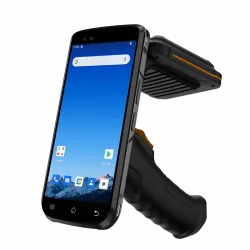
The CX1500N is our current flagship UHF RFID handheld reader for India, built for stock-taking, asset audits and field scanning jobs that run all day. It pairs a full Android 12 mobile computer with a long-range UHF module, so your team can read tags, run your inventory app and sync data over 4G or WiFi on a single device. An 11,550 mAh hot-swap battery keeps it running through a full shift, and it ships with our CX Flow Pro utility — one-tap scanning, keyboard-wedge data entry into any app, and a real-time webhook for live data push — plus a free SDK and demonstration application, making integration with existing ERP or inventory software straightforward.
Key specifications
- OS and platform: Android 12, octa-core 2.0 GHz, 4 GB RAM + 64 GB storage (8 GB + 128 GB optional; MicroSD up to 128 GB)
- UHF performance: EPC C1 Gen2 / ISO 18000-6C, 4.5 dBi ceramic antenna, adjustable transmit power, reading distance up to 25 m (tag-dependent)
- Frequency bands: 865-868 MHz (India and ETSI/EU), 902-928 MHz (US/FCC) and 920-925 MHz (China)
- Battery: 11,550 mAh removable Li-ion Polymer (3.7 V), hot-swappable for all-day endurance; fast charging in 2.5-3 hr
- Display: 6.0 inch touch screen, 720 x 1440, industrial Gorilla Glass
- Scan engine and cameras: integrated 1D/2D/QR scan engine (Zebra/Honeywell compatible); 5 MP front and 13 MP rear autofocus camera with flash
- Connectivity: 4G LTE (TD-LTE/FDD-LTE), dual-band Wi-Fi 802.11 a/b/g/n/ac, Bluetooth 5.1, GNSS (BeiDou/GLONASS/GPS/Galileo), USB Type-C with OTG
- Optional NFC: 13.56 MHz (MIFARE, NDEF, NfcV, Ultralight, IsoDep)
- Build and rating: 173 x 79 x 17 mm, under 641 g; IP67 dust and waterproof; 1.5 m drop onto 6 sides and 4 corners; operates from -10 to +50 deg C. We have removed a “certified CCC, CE and ISO 9001” line that sat here: those are not marks Identium holds, and this site says so plainly elsewhere. If a CE or CCC mark matters for your deployment, ask us and we will tell you what documentation the device itself actually carries rather than let a spec bullet imply it is ours.
Applications
- Warehouse and retail stock counting with bulk multi-tag reads
- Fixed asset verification across offices, plants and IT estates
- Goods receiving and dispatch checks in logistics hubs
- Field audits where 4G connectivity is needed away from WiFi
Specifying a CX1500N: what to decide before you order
Settle the region profile before dispatch
A handheld is an active transmitter, so its region profile — the channel plan, the permitted power, the spectrum-access behaviour — is the part a radio regulator cares about. On readers of this class the profile is typically a firmware setting, and a unit is normally dispatched configured to one region rather than running every band at once; on some models changing it afterwards is locked or needs a specific tool. So treat it as a purchase-order question, not a support question: tell us at order whether the unit stays in India or is being exported, and ask us in writing which profile your units will ship configured to and whether it can be changed in the field. Identium’s UHF readers and antennas are WPC-approved for India’s licence-exempt UHF RFID band.
For Indian use the device belongs on 865-868 MHz, the licence-exempt UHF RFID range under the WPC Wing’s short-range-device rules notified as G.S.R. 853(E) on 10 December 2021, made in supersession of the 2005 RFID rules that set 865-867 MHz. Within that range a reader may transmit at up to 2 W e.r.p. only on four channels of up to 200 kHz each, centred at 865.7, 866.3, 866.9 and 867.5 MHz, with continuous transmission on a channel capped at roughly 4 seconds and a gap of at least 100 ms between bursts. Notifications get amended, so confirm the current conditions with WPC before you freeze a specification. The 902-928 MHz profile is US/FCC territory — if captures look erratic on a newly delivered unit, the region setting is the first thing to check, not the tags.
The UHF module and the optional NFC module read different populations
The two are not interchangeable, and the difference is easy to lose on a purchase order.
| Read target | Module | Standard family |
|---|---|---|
| Carton, pallet, apparel and asset tags | Built-in UHF | EPC Gen2 / RAIN RFID (ISO/IEC 18000-63, formerly ISO 18000-6C) |
| Employee ID and access cards, NFC labels | Optional 13.56 MHz module | HF — ISO 14443 / ISO 15693, covering the MIFARE, Ultralight, NDEF, NfcV and IsoDep types in the specification above |
| Printed barcode or QR | Integrated scan engine | 1D/2D symbologies |
The UHF module will not read a 13.56 MHz card and the NFC module will not read a Gen2 tag — different frequency, different standard family. If card or NFC reads are in scope, specify the module on the purchase order, and ask us before assuming it can be fitted later. Livestock ear tags are different again: LF at 134.2 kHz under ISO 11784/11785, outside both of this device’s bands, so this is not the reader for that job.
What actually governs read performance
- The tag and its mounting surface, more than the reader. Any quoted distance assumes a well-matched tag in clear air. Metal and liquid detune a plain inlay, so on a difficult asset an on-metal or speciality tag does more than transmit power will.
- Lower power is often the fix. Cutting RF power shrinks the read zone, which is how you isolate one file or one tool instead of inventorying the whole rack behind it.
- Session, Q and dwell. Match Q to the tag population you actually have; check session, since in S0 tags typically reply repeatedly while energised while in S2 and S3 an inventoried tag goes quiet for a persistence period; and increase dwell before you touch power. How much of this your operators can reach depends on the application you run on the device, so raise it against your own software plan.
What to send us for an accurate quote
Memory configuration, whether the NFC module is needed, quantity, destination region, what you are tagging and what it is mounted on, and the distance you need to read at in the worst spot in the workflow. All read distances are typical and environment-dependent; we quote against a written specification rather than a headline figure.
Related reading
- UHF RFID reader price in India (2026), by reader type
- RFID frequency by country: getting the region profile right
- RFID tag not reading: a field troubleshooting order
The CX1500N replaces our earlier UHA-series handhelds and is available ex-stock in New Delhi with GST invoice and pan-India shipping. Request a quote for volume pricing and accessory options, or buy online at India RFID Store.
Who buys the CX1500N in India
Warehouse operators, retail chains and asset-audit teams across Delhi NCR and India choose the CX1500N when they need a rugged handheld RFID reader that lasts a full shift. Its Android 12 platform, up to 25 m read range and IP67 build suit RFID inventory management in stockrooms, fixed asset tracking across offices and plants, and goods receiving in logistics and warehousing hubs. Buyers comparing handheld RFID reader price in India typically weigh battery endurance, read range and software support — the CX1500N ships with a free SDK, demo app and the CX Flow Pro utility, so integration with existing ERP or inventory software stays straightforward. If you are still shortlisting models, our guide to choosing an RFID reader explains the trade-offs; for volume pricing and accessories, request a manufacturer quote.