

Warehouse & Logistics · UHF RFID
Warehouses that Run Themselves.
Identium’s RFID Warehouse Management System automates receiving, put-away, picking, and dispatch with UHF gate readers at every dock door and handheld scanners in every aisle — delivering the throughput modern 3PLs and ecommerce fulfilment centres demand.
Powerful Features
Built for Scale, Precision & Speed
Identium’s RFID Warehouse Management System automates receiving, put-away, picking, and dispatch with UHF gate readers at every dock door and handheld scanners in every aisle — delivering the throughput modern 3PLs and ecommerce fulfilment centres demand. Here are the capabilities you get with Identium.
Automated Receiving
Gate readers verify every carton/pallet against the ASN as it enters — discrepancies flagged in seconds.
Smart Put-Away
System suggests optimal bin based on velocity, volume, and co-pick affinity. RFID confirms placement.
Zero-error Picking
Handheld confirms the right SKU is picked — wrong-pick alerts before it leaves the station.
Dispatch Verification
Gate readers at outbound docks verify every order against the dispatch manifest.
Cross-docking
Direct gate-to-gate routing for goods that don’t need storage — minutes instead of days.
Carton & Pallet Hierarchy
Read the pallet, know every carton. Read the carton, know every SKU. Full hierarchy intact.
WMS / ERP Hooks
Ready integrations with SAP EWM, Oracle WMS, Manhattan, Blue Yonder, and Indian WMS platforms.
Throughput Dashboards
Dock-door utilisation, picking rates, and SLA compliance visible in real-time.
Inventory Security
Full audit trail — every movement of every SKU, with time, user, and zone.
How It Works
Three-Layer RFID Architecture
A clean flow from tagging to real-time dashboards — built for operational scale.
Tag cartons & pallets
UHF labels on every carton; pallet tags for bulk. Encoded at supplier, receiving, or kitting.
Read at every gate
Dock-door gate readers log inbound, outbound, cross-dock, and inter-zone movements.
WMS decides
Real-time reads drive put-away, pick lists, and dispatch verification in your WMS.
Hardware & Tags
Recommended Products
Enterprise-grade UHF/HF RFID hardware, sourced from our sister store IndiaRFIDStore.com.
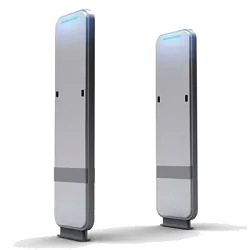
UHF RFID Gate Reader
Fixed UHF gate reader for automated entry/exit tracking at warehouse doors and checkpoints.
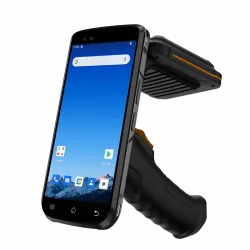
RFID Handheld Reader
Portable UHF scanners with Wi-Fi/BT connectivity for on-the-go asset verification and mobile audits.

UHF RFID Label (H10)
High-performance UHF label for non-metallic items — cartons, books, plastic cases, inventory labelling.
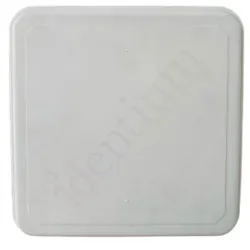
UHF RFID Antenna
Circular-polarised 9dBi/12dBi UHF antennas — extend reader range and multi-port coverage.
Use Cases
Deployed Across These Industries
Identium is trusted by organisations in manufacturing, retail, healthcare, logistics, events, and the public sector.
3PL Warehouses · Ecommerce FCs · Distribution Centres · Retail DCs · Cold Storage · Pharma WH · Port Bonds · Air Cargo
Automate your warehouse?
Pilot RFID at one dock door — expand across the site in weeks, not years.
Want the full technical deep-dive? Explore Warehouse Management on Identium One →
Related: Logistics & Warehousing · Healthcare & Pharma · Transportation
Specifying an RFID Warehouse System: Frequency, Read Points and Tags
Warehouse stock movement is a passive UHF job. In India that means the 865–868 MHz band, delicensed for RFID by the WPC’s 2021 short-range-device rules — confirm the current WPC notification before you freeze a specification. The air interface there is EPC Gen2, formally ISO/IEC 18000-63 and marketed as RAIN RFID, and it is what lets a reader pick up a whole pallet of cartons in a single pass. HF at 13.56 MHz (NFC, Mifare) and LF at 125/134 kHz are near-field technologies: fine for a staff access card at the gatehouse, no use for bulk reads across a shutter. Neither is EPC Gen2 or RAIN RFID, whatever a spec sheet claims — those terms describe passive UHF only, and seeing them against an HF line item is the fastest way to spot a BoQ that has been copied rather than scoped. Readers and antennas going into an Indian site should be WPC-approved for the Indian band. Identium is BIS certified, manufactures its tags in New Delhi, and supplies UHF readers and antennas that are WPC-approved for India’s licence-exempt UHF RFID band.
Where the hardware sits matters more than the headline spec:
| Read point | What gets tagged | Suitable hardware |
|---|---|---|
| Inbound / outbound dock door | Carton labels, pallet tags | Fixed gate/portal reader with circular-polarised panel antennas — more than one antenna per opening where you need to infer direction of travel |
| Aisle counts, put-away checks | Same tags | Android handheld reader; expect shorter range than a fixed portal |
| Packing bench, kitting, relabelling | Blank UHF labels | RFID label printer, plus a desktop reader to verify the encode |
| Steel racking, cages, trolleys, drums | Location and asset IDs | On-metal (anti-metal) hard tags — a flat paper label detunes badly against metal |
| Returnable plastic pallets and bins | Pool assets | Rugged UHF pallet tags, riveted or cable-tied rather than stuck on |
Two constraints catch out most first deployments. Dock doors set close together can cross-read, so shape the zone with higher-gain, narrow-beam antennas aimed downward and trim output power rather than raising it. And foil-lined cartons, shrink-wrapped liquids and dense metal stock all absorb or reflect UHF, so tag the outward face and confirm distances in your own aisle. Typical passive UHF reads up to roughly 10–15 m with a fixed reader and less with a handheld, but that figure moves with every rack, roller and wrapped pallet you put near it.
Every reader we supply ships with an SDK, a demo application and source code. That matters more than it sounds. A dock-door read stream arrives as thousands of repeat reads of the same tag, and it has to be de-duplicated, held long enough to decide the pallet has actually crossed the line, and mapped onto your own document flow before it is worth anything to a WMS. Having the source means that layer belongs to you and can be changed when the process changes, instead of being a fixed connector the warehouse has to work around.