

Retail & Commerce · UHF RFID
Inventory Accuracy, from 65% to 99%.
Manual inventory counts plateau at 65–75% accuracy. Identium’s RFID Inventory Management delivers 99%+ — automatically, in minutes, across every store and warehouse. Stop stockouts. End over-ordering. See real SKU-level truth.
Built for Scale, Precision & Speed
Manual inventory counts plateau at 65–75% accuracy. Here are the capabilities you get with Identium.
Automated Cycle Counts
Walk the aisle with a handheld — entire shelf counted in seconds. No removing items. No ladders.
SKU-level Truth
Real inventory positions, not guesswork. Every hang-tag, label, or UHF inlay reports in.
Stockout Prevention
Low-stock alerts fire the moment a fast-mover drops below reorder point.
Omnichannel Fulfilment
Exact location of every SKU across stores enables BOPIS and ship-from-store.
Receiving Automation
Gate readers at receiving dock verify every carton against the PO — discrepancies flagged instantly.
POS Integration
RFID reads at POS automatically decrement inventory — no manual scan required.
Demand Analytics
Sell-through, slow-movers, dead stock — all surfaced with SKU accuracy you can trust.
Label & Hangtag Options
Pre-encoded tickets, adhesive labels, or hangtags — matched to your packaging workflow.
ERP Integration
Bi-directional sync with SAP, Oracle, Dynamics, Tally — inventory truth across every system.
Three-Layer RFID Architecture
A clean flow from tagging to real-time dashboards — built for operational scale.
Tag every SKU
UHF hangtags, labels, or embedded inlays encoded with SKU + serial at source or receiving.
Scan with handhelds
Associates count shelves, back-rooms, and stockrooms in minutes, not hours.
Live dashboard
Real-time stock truth flows to ERP, ecommerce, and store ops dashboards.
Recommended Products
Enterprise-grade UHF/HF RFID hardware, sourced from our sister store IndiaRFIDStore.com.
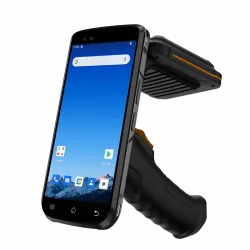
RFID Handheld Reader
Portable UHF scanners with Wi-Fi/BT connectivity for on-the-go asset verification and mobile audits.

UHF RFID Label (H10)
High-performance UHF label for non-metallic items — cartons, books, plastic cases, inventory labelling.
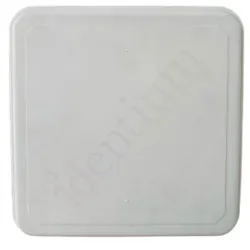
UHF RFID Antenna
Circular-polarised 9dBi/12dBi UHF antennas — extend reader range and multi-port coverage.

UHF RFID Gate Reader
Fixed UHF gate reader for automated entry/exit tracking at warehouse doors and checkpoints.
Deployed Across These Industries
Identium is trusted by organisations in manufacturing, retail, healthcare, logistics, events, and the public sector.
Apparel Retail · Electronics · F&B Distribution · Pharma · Grocery Chains · Multi-store Retail · Bookstores · Gift & Home
Ready for 99% inventory accuracy?
Pilot Identium’s RFID inventory system in one store — scale to your whole chain.
Want the full technical deep-dive? Explore Inventory Management on Identium One →
Related: Logistics & Warehousing · Luxury industry · Healthcare & Pharma
Specifying an RFID Inventory System for Indian Stores and Warehouses
Inventory counting is one of the few RFID applications where the frequency question is not really a debate. Stock takes need to read hundreds of tags at once, at a distance, without line of sight — so the answer is passive UHF on India’s 865–868 MHz band, using EPC Gen2 (ISO/IEC 18000-63) chips, the standard marketed as RAIN RFID. HF at 13.56 MHz and NFC work at centimetre range, which is right for a payment or access card but no use for counting a full rack. If you are importing readers, check they are region-set for 865–868 MHz and not the US 902–928 MHz band. That band is delicensed for RFID in India under the 2021 WPC short-range-device rules; confirm the current WPC and BIS position before you import, and see our BIS and WPC compliance guide for what the paperwork involves. Identium is BIS certified, and the UHF readers and antennas we supply are WPC-approved for the Indian band.
The hardware follows the task rather than the other way round.
| Inventory task | Suitable hardware | What decides the result |
|---|---|---|
| Shelf and back-room cycle counts | Android UHF handheld | Reads a whole bay without unpacking; range is typically shorter in densely packed stock than in open air |
| Goods-in and despatch verification at the door | Gate or portal reader | Reads a loaded trolley or pallet in one pass; portal width, tag placement and how tightly the stack is packed set the read rate |
| Unattended zone or smart-shelf monitoring | Multi-port fixed reader with directional antennas | Typically up to around 10–15 m from a fixed reader with good antenna placement, though the environment decides |
| Encoding labels at receiving | Desktop RFID printer | Prints and encodes a serialised label in one pass |
Tag selection is decided by the packaging, not by the SKU:
- Cartons, boxes, garments, paper and plastic packs — standard UHF inlays and labels.
- Metal shelving, tools, gas bottles, foil-lined pouches and liquid-filled containers — these detune a flat label, so use on-metal hard tags instead.
- Items that must be tracked individually rather than only by SKU — remember the EPC is an identifier, not a database. Keep description, price and location in your own system and treat the encoded number as the key, so two identical shirts stay two distinct records without loading business data onto the tag.
The practical failure mode in Indian stockrooms is the stray read: a handheld at full power picking up stock in the next aisle, or behind a plasterboard wall. Reducing transmit power, filtering weak reads by signal strength, and shielding or tightly focusing the antennas where the read zone must be bounded will usually settle it. Test the read behaviour on one bay and one carton type before you fix a tag specification for the whole chain — packaging varies between SKUs far more than the reader does.