

Smart Cities · UHF RFID
Every Bin. Every Lift. Tracked.
Identium’s RFID Waste Management tags every garbage bin with a rugged UHF tag and every collection truck with a reader. Every lift is logged with time, location, weight, and waste-type — driving accountability for municipalities, ULBs, industries, and housing societies.
Built for Scale, Precision & Speed
Identium’s RFID Waste Management tags every garbage bin with a rugged UHF tag and every collection truck with a reader. Here are the capabilities you get with Identium.
Bin-level Identification
Every bin tagged with a rugged UHF tag — household, commercial, industrial, and municipal bins all uniquely identified.
Truck-mounted Readers
UHF readers on collection vehicles automatically log every bin lift with GPS location and timestamp.
Segregation Enforcement
Colour-coded tags for dry/wet/hazardous/bio-medical — wrong bin on wrong truck raises alerts.
Route Optimisation
Missed bins flagged; route completion visible in real-time for the ULB or facility manager.
Weight-based PAYT
Pay-as-you-throw billing — integrate RFID reads with on-truck weighing for accurate invoicing.
SLA Compliance
Proof of collection for every bin — with photo and time evidence for SLA reports.
Industrial Waste Chain of Custody
Hazardous waste tracked from generator to disposal — regulatory-compliant audit trails.
Fill-level Alerts
Smart bins with sensors alert when full — collect before overflow, skip when not needed.
Analytics & Citizen Portal
Heatmaps of generation, citizen complaints mapped to bins, KPI dashboards for ULB officers.
Three-Layer RFID Architecture
A clean flow from tagging to real-time dashboards — built for operational scale.
Tag every bin
Rugged on-metal UHF tags mounted on every bin — household, commercial, municipal.
Reader on the truck
Truck-mounted UHF reader + GPS + optional weigh-cell logs every lift automatically.
Cloud intelligence
SLA dashboards, route optimisation, PAYT billing, and citizen portals run on real-time data.
Recommended Products
Enterprise-grade UHF/HF RFID hardware, sourced from our sister store IndiaRFIDStore.com.
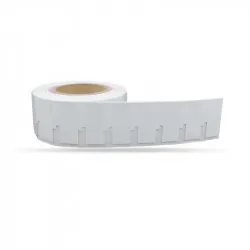
Flexible On-Metal Label 60x25
Printable flexible on-metal UHF label — perfect for IT assets, tools, and small metallic equipment.
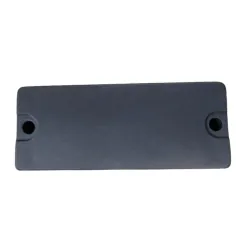
RFID Metal Tag (Encore)
Rugged UHF tag engineered for metal assets — machinery, equipment, tools, industrial asset tracking.
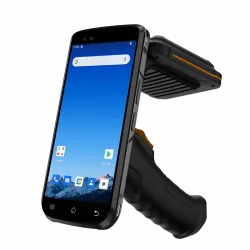
RFID Handheld Reader
Portable UHF scanners with Wi-Fi/BT connectivity for on-the-go asset verification and mobile audits.

UHF RFID Gate Reader
Fixed UHF gate reader for automated entry/exit tracking at warehouse doors and checkpoints.
Deployed Across These Industries
Identium is trusted by organisations in manufacturing, retail, healthcare, logistics, events, and the public sector.
Municipal ULBs · Smart Cities · Housing Societies · Industrial Estates · Bio-medical Waste · Commercial Complexes · Hotels & Resorts · Airports
Clean cities, measured.
Pilot RFID bin tracking on one ward — scale across the city.
Want the full technical deep-dive? Explore Waste Management on Identium One →
Related: Transportation · Infrastructure · Healthcare & Pharma
Specifying the hardware: what a bin route actually demands
The frequency question settles itself once you look at the collection cycle. A loader has only a few seconds beside the bin while the lifter arm swings, and the tag has to read reliably at roughly a metre, not at a tap — through grime, at whatever angle the bin happens to be facing. HF at 13.56 MHz and NFC are near-field technologies that in practice read at centimetres, which is fine for a doorstep sticker a supervisor touches but not for community bins or a truck-mounted read. So bin tracking is passive UHF on India’s delicensed 865–868 MHz band, notified under the 2021 WPC short-range-device rules, using EPC Gen2 — the passive-UHF-only standard published as ISO/IEC 18000-63 and marketed as RAIN RFID. Its anti-collision behaviour is what lets a reader work through a cluster of bins in quick succession rather than one tap at a time, though how well that holds up depends on tag spacing and orientation.
Beyond frequency, the bin’s surface decides the tag:
| Collection point | Surface | Tag to specify | Typical fixing |
|---|---|---|---|
| Household or doorstep bin (typically 120–240 L) | HDPE plastic | Rugged UHF hard tag, non-metal mount | Rivet or adhesive under the lip |
| Community bin, dumper placer, skip | Steel | On-metal (anti-metal) UHF tag | Rivet, cable tie or epoxy |
| Collection-point marker or gate post | Steel | On-metal UHF tag in a larger housing | Rivet or epoxy |
| Bio-medical or hazardous drum | Metal or HDPE | Sealed rugged UHF tag, serial-numbered | Cable tie or epoxy |
Three field constraints decide whether a pilot survives the monsoon. First, mounting position: fix the tag on the outer front face or lip, clear of the lifting comb and well above the base where leachate pools — a full wet-waste bin sitting behind the tag will pull range down, because water absorbs UHF energy. Second, ruggedisation: ultrasonic welding and epoxy potting are what keep dust, UV and pressure-washing out of the tag body. Third, re-issue: bins get damaged and tags get scraped off, so laser-mark a human-readable number that matches the ULB’s bin asset register and keep spares from the same batch, encoded to the same scheme.
On the reader side, door-to-door crews are usually best served by an Android handheld running the collection app on the same device, while mechanised lifting suits a fixed reader with an external antenna aimed at the lifter arm — which makes antenna height, tilt and polarisation more important to get right than raw reader power. Expect a fixed reader with a well-aimed external antenna to reach further than a handheld, and expect an on-metal tag on a steel bin to read shorter than the same tag’s free-air figure; both are typical behaviour, not guarantees, and both move with mounting, weather and how full the bin is. Scope them against your own bins before writing a number into a specification.
As of 2026, UHF readers and antennas deployed in India require WPC approval, and Identium’s are WPC-approved for India’s licence-exempt UHF RFID band — confirm current requirements against WPC and BIS at the time you buy, as covered in our BIS and WPC compliance guide. Every reader ships with an SDK, demo app and source code, so read events can be pushed into the ULB’s existing dashboard instead of standing up a separate silo.