
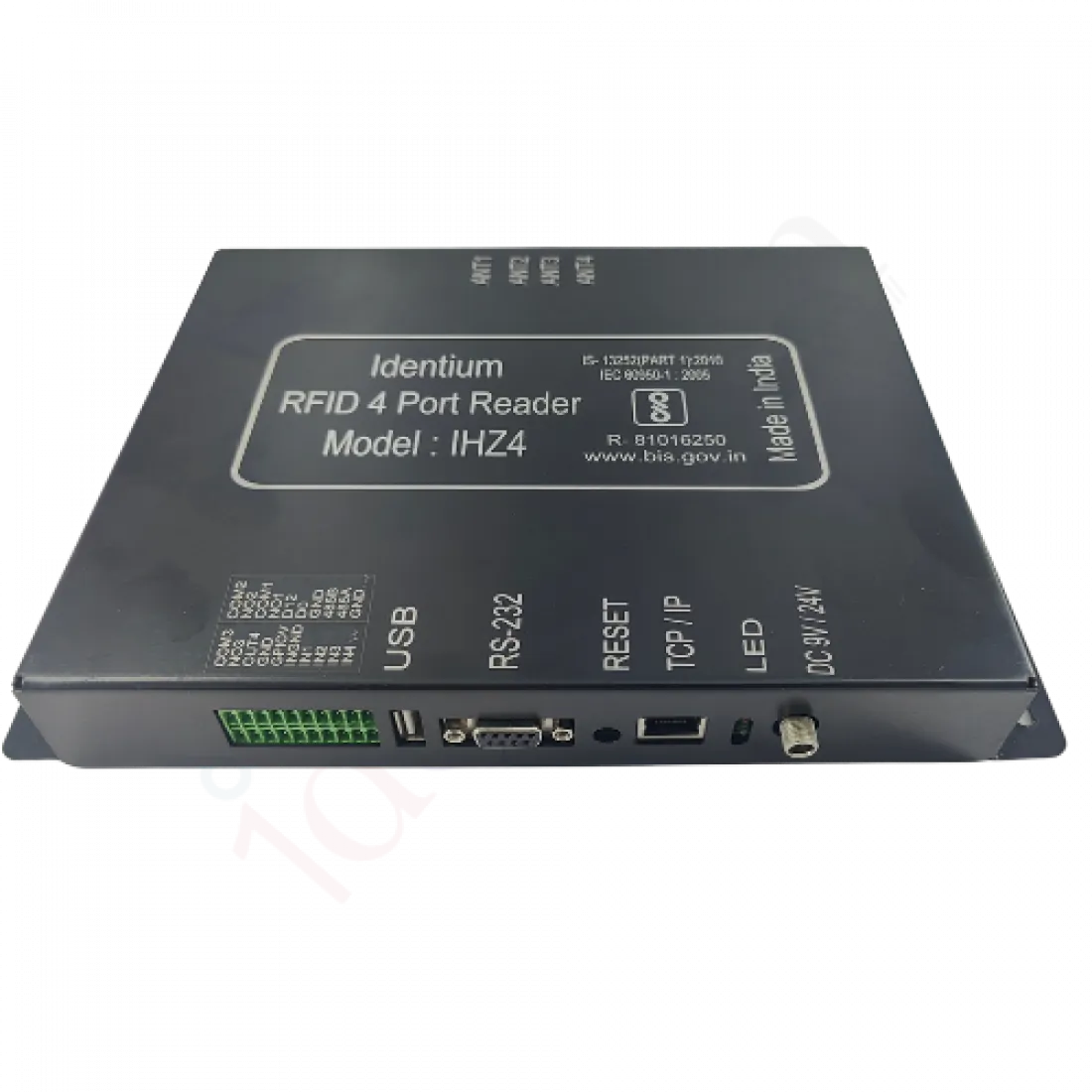
The IHZ4 is Identium’s current-generation four-port UHF RFID fixed reader, built around the Impinj E710 module with a double power amplifier circuit. It is the workhorse we recommend for dock doors, gates, conveyor lines and race-timing setups anywhere in India where read accuracy and range matter most. A WiFi-enabled version, the IHZ4(Wifi), and a POE-powered version are available on the same platform, so you can pick the connectivity that suits your site wiring.
Key specifications
- Chipset: Impinj E710 with dual power amplifier design
- Read performance: over 700 tag reads per second; read range 0-30 m and write range 0-8 m depending on antenna and environment
- Protocols: ISO/IEC 18000-6B/6C and EPC C1Gen2; 865-868 MHz (India’s licence-exempt allocation, also the ETSI band) and 902-928 MHz (FCC) bands
- RF output: 0-33 dBm, adjustable in 1 dBm steps
- Antenna ports: 4 x SMA for external UHF antennas
- Interfaces: RS-232, RS-485, Wiegand, RJ45 Ethernet and USB 2.0, with WiFi or Bluetooth as add-ons; 3 inputs and 3 relay outputs for boom barriers, lights and alarms
- Developer support: Java, .NET and C++ APIs plus a Direct Post API; software features include RSSI reporting, antenna detection, data filtering and online updates
- Build: die-cast aluminium housing, 170 x 120 x 25 mm, 0.5 kg, working temperature -20 to +70 deg C
Applications
- Vehicle and boom-barrier access control
- Warehouse dock door and gate reading
- Production line and WIP tracking
- Race timing and sports event scoring
- Library and file movement security
Specifying the IHZ4: sizing the ports, setting the power
Four ports means four zones, not four simultaneous readers. A multi-port reader serves its antennas in sequence, so read the 700-plus reads per second as a reader-level figure shared across the ports you enable rather than a guaranteed per-port rate — and like any throughput number it is typical, varying with tag population, antenna layout and environment. Where every lane has to be watched continuously at full rate, ask us to check the antenna cycling behaviour against your scan rate before settling on one reader rather than two; where lanes peak at different times, one IHZ4 across four zones is usually the cheaper build. That same sequencing is what lets you infer direction of travel from the order in which ports see a tag.
0-33 dBm is the figure at the antenna port, not radiated power. e.r.p. adds antenna gain and subtracts cable loss, so the same 33 dBm setting does not sit the same way behind a 9 dBi antenna as behind a 12 dBi one. India’s licence-exempt UHF RFID band is 865-868 MHz under G.S.R. 853(E) of 10 December 2021, made in supersession of the 2005 rules that set 865-867 MHz — so treat a datasheet still quoting 865-867 MHz as out of date, though Rule 1(3) grandfathers type approvals issued under the older rules for their service life, so an older approval is not void. Table IV of the 2021 rules permits 2 W e.r.p. only in the four channels of up to 200 kHz centred at 865.7, 866.3, 866.9 and 867.5 MHz, with continuous transmission limited to 4 s per channel and at least 100 ms between bursts. Those dwell and gap limits are a matter of how the unit’s channel hopping is configured, not of how many hours your gate runs. Confirm the unit is set to the Indian band and not the 902-928 MHz FCC plan the same platform also covers, and confirm the limits current for your configuration with WPC.
The ISO/IEC 18000-6C and EPC C1Gen2 support listed above is the protocol now published as ISO/IEC 18000-63, the same thing sold as RAIN RFID — passive UHF only. So if staff already carry a 13.56 MHz employee card, no UHF reader will see it whatever its power setting: the Wiegand output will pass UHF tag IDs to your existing access panel, but the card itself needs an HF 13.56 MHz reader alongside.
What actually decides the build
| If your site has | Plan for |
|---|---|
| A barrier, light or alarm on all four lanes | Three relay outputs on board — a fourth driven device needs external relay switching or a second reader |
| Antennas far from the reader | Short, low-loss coax and the reader near the portal; cable loss eats antenna gain before the tag sees it |
| No mains point at the gate | The POE variant, rather than retro-fitting power |
| Tags on metal or near liquids | An on-metal tag and shorter range; treat 0-30 m as a typical upper figure in clear air, not a guarantee |
Send us antenna count and gain per port, cable run length per port, the host interface, the number of relay-driven devices, and what the tags mount on. That is what we need to quote against a written specification.
Related reading
- UHF RFID antenna guide: gain and polarization per port
- How to scope read range against your environment
- BIS and WPC compliance for RFID in India: a buyer’s guide
For sites that need on-reader intelligence, Identium also offers the IHZ4AI, an AI-enabled reader variant on the same family — see the IHZ4AI at India RFID Store. The IHZ4 succeeds our earlier ICL4 and 401F fixed readers and ships ex-stock from New Delhi. Request a quote with your antenna count and site details, or buy online at India RFID Store: standard IHZ4, IHZ4(Wifi) or the POE version.
Who buys the IHZ4 in India
Buyers comparing 4-port UHF RFID fixed reader prices in India typically shortlist the IHZ4 for multi-antenna chokepoints: warehouse dock doors, factory gates, boom-barrier lanes and race-timing setups. One reader with four SMA ports can cover a full portal, which usually works out more economical per lane than stacking single-port units. System integrators specify it for RFID warehouse management and vehicle parking management because its three relay outputs drive boom barriers, lights and alarms directly, while Wiegand output connects to existing access-control panels. Sports-timing firms deploy it for race timing and event scoring, and factories run it on conveyor lines for production and WIP tracking. Final cost depends on the variant — standard, IHZ4(Wifi) or POE — plus antenna count and order volume, so request a manufacturer quote with your site details.