

Logistics · UHF RFID · Sensors
Shipment Visibility, End to End.
Identium’s RFID Logistics & Supply Chain platform tracks cartons and pallets from origin hub to destination with UHF gate reads at every transit point. Condition-monitoring sensor tags log temperature and shock — essential for cold-chain pharma and high-value goods.
Built for Scale, Precision & Speed
Identium’s RFID Logistics & Supply Chain platform tracks cartons and pallets from origin hub to destination with UHF gate reads at every transit point. Here are the capabilities you get with Identium.
Carton & Pallet Tracking
UHF labels on every carton — gate-read at every hub transition.
Cold-chain Monitoring
Battery-free sensor tags log temperature every 5 minutes — alerts on excursion.
Shock Detection
Impact-detecting tags prove damage happened in transit, not at destination.
Dock-door Automation
Every truck load-in and load-out verified against the ASN — no lost cartons.
Hub-to-hub Timeline
Live timeline per shipment: “picked up at Delhi hub 9:40, Gurgaon hub 14:20…”
Proof of Delivery
Final-mile handheld reads provide digital POD with time, location, and signature.
SLA Analytics
On-time performance, hub dwell times, exception rates by lane, driver, and customer.
TMS & ERP
Real-time data into Transport Management Systems and shipper ERPs.
Customs Ready
Tag-level manifests speed up customs clearance for international lanes.
Three-Layer RFID Architecture
A clean flow from tagging to real-time dashboards — built for operational scale.
Tag at origin
UHF labels applied at the shipper dock or pre-printed on outer cartons.
Scan at every hub
Gate readers at DCs, hubs, and dock doors log every transit event.
POD + analytics
Digital POD at the door; end-to-end visibility for shippers and consignees.
Recommended Products
Enterprise-grade UHF/HF RFID hardware, sourced from our sister store IndiaRFIDStore.com.

UHF RFID Gate Reader
Fixed UHF gate reader for automated entry/exit tracking at warehouse doors and checkpoints.
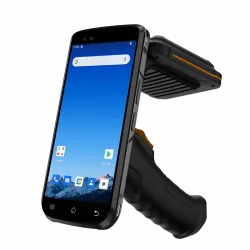
RFID Handheld Reader
Portable UHF scanners with Wi-Fi/BT connectivity for on-the-go asset verification and mobile audits.

UHF RFID Label (H10)
High-performance UHF label for non-metallic items — cartons, books, plastic cases, inventory labelling.
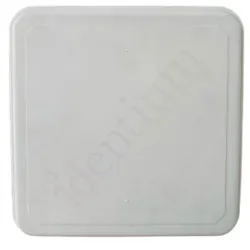
UHF RFID Antenna
Circular-polarised 9dBi/12dBi UHF antennas — extend reader range and multi-port coverage.
Deployed Across These Industries
Identium is trusted by organisations in manufacturing, retail, healthcare, logistics, events, and the public sector.
Parcel Carriers · 3PL Logistics · Cold Chain · Air Cargo · Ocean Freight · Rail Freight · Pharma Distribution · Sample Logistics
Visibility across every hub.
Let’s wire up one lane first — the ROI surfaces in a month.
Want the full technical deep-dive? Explore Logistics & Supply Chain on Identium One →
Related: Logistics & Warehousing · Transportation · Healthcare & Pharma
Specifying the Hardware for an RFID Supply Chain Management System
Supply chain work sits firmly in passive UHF. In India that means the 865–868 MHz band, which the WPC delicensed for RFID in its 2021 short-range-device rules — Identium is BIS certified, and the UHF readers and antennas we supply are WPC-approved for India’s licence-exempt UHF RFID band. Check the current WPC and BIS notifications before you import or commission anything, since the allocation and the approval lists are theirs to change. Passive UHF is the layer that can read a stacked pallet or a whole dock-door pass without line of sight and without presenting items one at a time, and because it follows EPC Gen2 (ISO/IEC 18000-63, marketed as RAIN RFID), a carton encoded at a supplier’s dispatch desk stays readable on any compliant reader on the same regional band at the receiving hub. HF 13.56 MHz and NFC are the wrong layer for this job — they work over centimetres at a fixed read point, not across a portal while a loaded pallet rolls through. Worth being precise about the vocabulary: EPC Gen2, ISO/IEC 18000-63 and RAIN RFID are passive-UHF terms only, and do not describe HF, NFC or LF products.
What usually decides whether a lane works is not the reader but what is inside the packaging. Liquids absorb UHF energy and metal reflects it, so the tag has to be matched to the load:
| Shipment unit | Surface | Tag to specify | Read point |
|---|---|---|---|
| Fibreboard carton, dry goods | Paper, plastic | UHF paper or PET label, printed and encoded in one pass | Dock portal, handheld at delivery |
| Plastic pallet, crate or bin | Non-metallic | Rigid ABS/PC hard tag, riveted or bonded | Gate and dock portals |
| Steel cage, roll cage, stillage | Metal | On-metal (anti-metal) tag — expect noticeably shorter range | Close-range dock read |
| Liquid-filled or foil-lined cartons | RF-hostile | Spaced on-metal construction, tag on the carton edge | Slow-pass portal |
Treat every published range figure as typical rather than guaranteed. A fixed multi-port reader with circular-polarised antennas over a dock door will usually out-read a handheld, but aisle geometry, forklift speed, pallet density and the contents of the cartons all move the result, and on-metal or small-footprint tags read shorter again. Prove the read rate on your worst case first — a steel cage, or a liquid-filled carton buried mid-pallet — because that load is what sets the tag specification for everything else.
Two decisions decide whether the reads become usable data. First, encode a unique serial per carton in EPC memory instead of a shared SKU value: a shared code lets you count stock, but not reconcile a read against a specific ASN line, and not tell a re-scan of one carton from the arrival of a second. Second, treat the read stream as something that needs filtering before anything downstream sees it — a portal sees the same tag many times in a single pass, so the software has to collapse those into one event and infer direction of travel from the antenna sequence. Every reader Identium supplies ships with an SDK, demo app and source code, so that logic can be written against your own stack rather than bolted on afterwards. Custom tags are typically a 5–10 day turnaround, and units are tested in-house before dispatch.
Related reading
- Working to a customer’s tagging mandate: supplier guide to retailer RFID mandates.
- Temperature-sensitive lanes: RFID cold chain temperature monitoring in India.
- The unit-load layer: UHF RFID pallet tags made in India.