

HR Tech · HF/UHF RFID
Hiring Events, Finally Measurable.
Turn chaotic career fairs and campus drives into data-driven hiring funnels. RFID badges follow each candidate through registration, aptitude rounds, group discussions, and final interviews — giving HR a complete pipeline view.
Powerful Features
Built for Scale, Precision & Speed
Turn chaotic career fairs and campus drives into data-driven hiring funnels. Here are the capabilities you get with Identium.
RFID Candidate Badges
Each candidate gets an RFID badge at registration — no name tags, no manual sign-in sheets.
Pipeline Visibility
See which candidates are at which stage — aptitude, GD, interview — in real-time.
Round Timings
Automated start/end timestamps per round for compliance and candidate experience analytics.
Interviewer Allocation
RFID-driven queue management — next candidate is automatically assigned to the free interviewer.
Feedback Capture
Interviewers submit scored feedback tied to the candidate badge — no email chains.
Shortlist Exports
One-click shortlist export with scores, feedback, and round history.
Multi-Campus Rollout
Run the same flow across IITs, NITs, tier-2 campuses — consistent data model.
ATS Integration
Push hired candidates into your ATS (Naukri RMS, Workday, SuccessFactors).
Candidate Comms
Auto-SMS/email for round shortlisting, offers, rejections.
How It Works
Three-Layer RFID Architecture
A clean flow from tagging to real-time dashboards — built for operational scale.
Register & badge
Candidates scan QR to register; an RFID badge is handed over with their ID encoded.
Track every round
Desk readers at each round auto-log participation, timing, and outcome.
Shortlist & hire
HR gets a live pipeline with scores; shortlisting and offers happen in the same UI.
Hardware & Tags
Recommended Products
Enterprise-grade UHF/HF RFID hardware, sourced from our sister store IndiaRFIDStore.com.
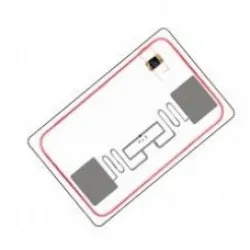
RFID Smart Card
HF / UHF / dual-frequency RFID cards for access, attendance, library, and ID use-cases.
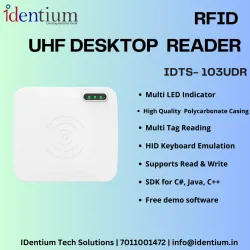
UHF Desktop Reader
Compact desk-mounted reader/writer for encoding tags, issuing cards, and point-of-service scanning.
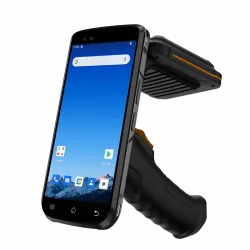
RFID Handheld Reader
Portable UHF scanners with Wi-Fi/BT connectivity for on-the-go asset verification and mobile audits.
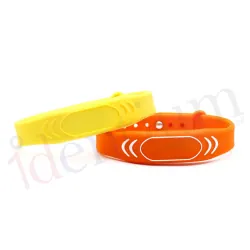
RFID Silicone Wristband
Comfortable silicone RFID wristband for events, attendance, patient ID, and cashless payments.
Use Cases
Deployed Across These Industries
Identium is trusted by organisations in manufacturing, retail, healthcare, logistics, events, and the public sector.
Campus Hiring · Career Fairs · University Drives · Lateral Drives · Walk-in Interviews · Startup Hackathons · Case Competitions · Assessment Days
Next campus drive?
Deploy Identium’s RFID recruitment system — turnkey in 2 weeks.
Want the full technical deep-dive? Explore Recruitment Management on Identium One →
Related: Education · IT Industry · Manufacturing
Which frequency a hiring drive actually needs
Recruitment tracking is a tap application, not a hands-free one. Every entry in the log is a deliberate act by one named candidate, and the record is only worth keeping if it is unambiguous. That points to HF 13.56 MHz (ISO/IEC 14443 — the Mifare and DESFire family, or an NFC-readable chip where you want phone reads) rather than UHF.
The reason is selectivity. In a crowded hall with a queue pressing up behind the desk, a passive UHF reader can pick up badges well beyond the person actually standing at it, and write the wrong candidate into a round. HF’s typical range of a few centimetres is the feature here: the tap is the consent signal, and nobody is marked present for a GD they merely walked past. An NFC-readable badge is also read by most NFC-capable Android phones, so a panel room running for a single day need not have a reader of its own.
Two practical points. Encode a meaningless serial and keep the candidate record in your own software — badges leave the venue with the people wearing them, and no personal data should sit on the chip. A plain serial reads fine from a Mifare-class chip; choose DESFire where you want authenticated reads. And HF antennas detune against metal, so a desk reader sitting on a steel table will typically lose range — a non-metallic spacer, or a reader built for metal mounting, is the usual fix.
| Where in the drive | Credential | Frequency / chip | Typical range |
|---|---|---|---|
| Registration and encoding desk | Printed PVC or PETG card | HF 13.56 MHz (ISO/IEC 14443, Mifare / DESFire) | A few cm |
| Round desks, GD, panel rooms | Same badge, tapped | HF 13.56 MHz, NFC-readable chip for phone reads | A few cm |
| Multi-day or outdoor drives | Silicone wristband | HF 13.56 MHz | A few cm |
| Optional hall-entry headcount | UHF card or badge insert | 865–868 MHz passive UHF (EPC Gen2 / ISO/IEC 18000-63) | Metres; depends on tag, reader and surroundings |
Only that last row is RAIN RFID territory — the EPC Gen2 / ISO/IEC 18000-63 label describes passive UHF and nothing else in this table — and it earns its place only if you want arrivals counted against registrations without forming a queue. India’s UHF band is 865–868 MHz, delicensed under WPC; as of 2026 the UHF readers and antennas we supply for India are WPC-approved, and Identium is BIS certified. Confirm the current position with WPC and BIS for your own tender or purchase paperwork.
Badges are made at our Delhi factory, with printing, serial numbering and encoding done in-house and units tested before dispatch; custom artwork runs typically take 5–10 days. And because HF badges are rewritable, cards and wristbands collected at the exit can be re-encoded and reissued for the next campus.