
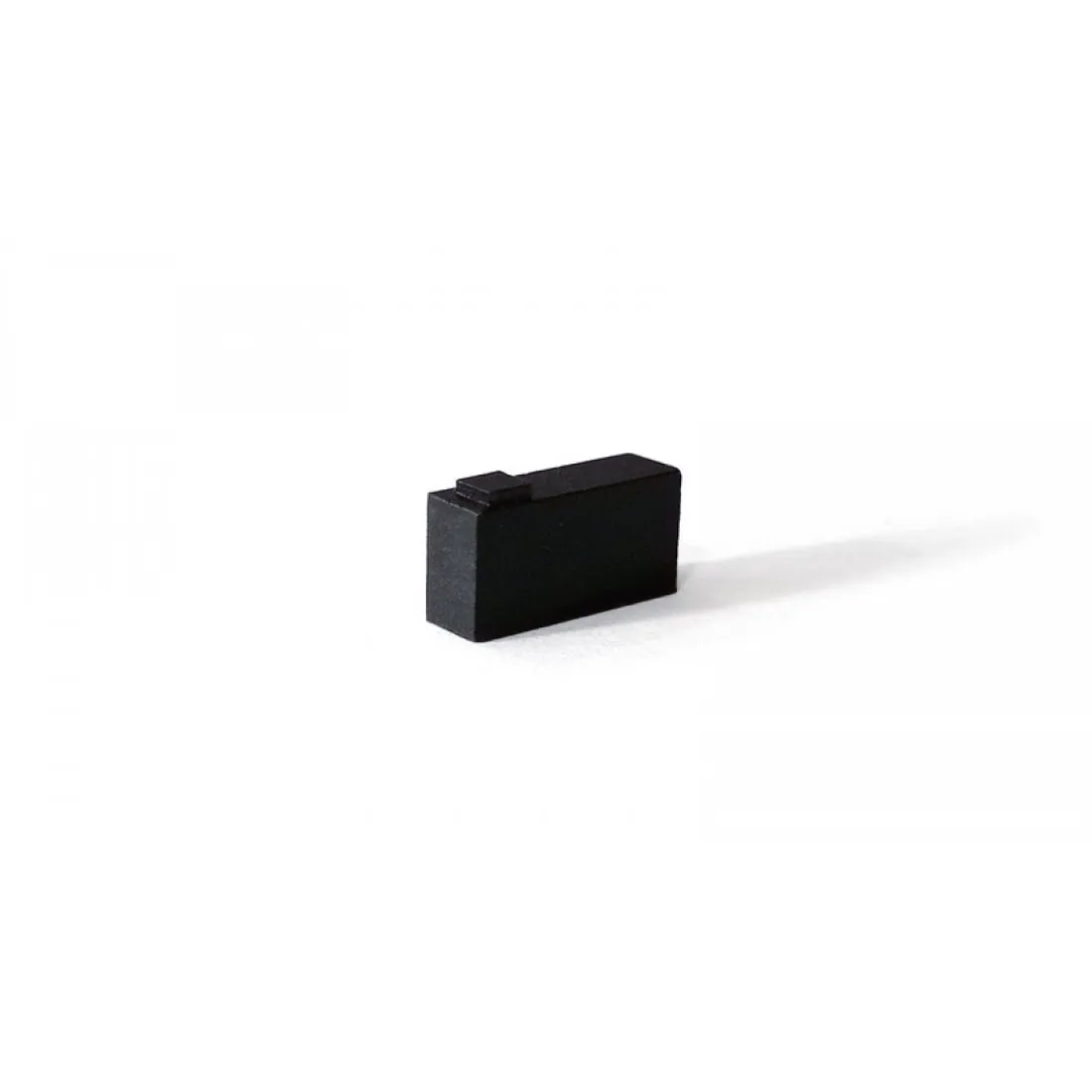
The Identium CR400 is a miniature ceramic UHF RFID tag purpose-built for metal assets that ordinary labels cannot handle. At just 10 x 5 x 3 mm it tucks onto spanners, moulds, dies, surgical instruments, IT equipment and machine parts, yet the ceramic antenna design uses the metal surface to its advantage and still delivers around 2 m of read range from a fixed reader. With an IP68 sealed body and a -40 to +100 deg C operating window, it keeps reading through washdowns, oil, dust and outdoor exposure — conditions that destroy adhesive paper labels within weeks.
Key specifications
- Size: 10.0 x 5.0 x 3.0 mm; black ceramic body with adhesive mounting
- Chip: Alien Higgs-3 with 96-bit EPC, 512-bit user memory and 64-bit TID
- Protocol: EPC Class 1 Gen 2 / ISO 18000-6C
- Frequency: 865-867 MHz (India variant) and 902-928 MHz (US variant) — these are the datasheet’s tuning variants; India’s licence-exempt allocation is 865-868 MHz under the 2021 WPC short-range-device rules, and the India variant sits inside it
- Read range on metal: up to 2.0 m with a fixed reader, around 1.0 m with a handheld
- Durability: IP68 rated; operating temperature -40 to +100 deg C, storage up to +150 deg C
- Memory life: 100,000 write cycles and 50-year data retention
- Compliance: REACH, RoHS and CE
Applications
- Tool and instrument tracking in workshops, hospitals and MRO stores
- Mould, die and fixture identification on production lines
- IT and electronic asset audits where label space is tight
- Equipment maintenance records on pumps, motors and valves
- Defence and high-value inventory where tags must survive harsh handling
Specifying the CR400: what actually decides the read
Band first. A ceramic on-metal tag of this type is passive UHF — EPC Class 1 Gen 2, published as ISO/IEC 18000-63 and sold as RAIN RFID — because tool cribs, MRO stores and plant audits need metres of range and many tags answering in one sweep. HF at 13.56 MHz (ISO 14443/15693, NFC) works at centimetres, not metres: fine for an access card, wrong for a drawer of sockets. LF at 134.2 kHz under ISO 11784/11785 is animal identification.
For an Indian site, that means taking the India/ETSI-band variant rather than the US 902–928 MHz one. Datasheets for the India variant — ours included — still print 865–867 MHz. That was the figure in the 2005 Rules, superseded on 10 December 2021 by G.S.R. 853(E), which sets the licence-exempt allocation at 865–868 MHz; Rule 1(3) keeps equipment type-approved under the older Rules effective for the rest of its service life, which is why the old number persists on paper. India and ETSI now share 865–868 MHz, so a datasheet quoting that range is not evidence a part was built for Europe rather than here. The regional mismatch that actually bites is North American stock fixed near 902–928 MHz.
The approval generally sits with the reader rather than the passive tag. Table IV of the 2021 Rules permits 2 W e.r.p. only inside four channels of up to 200 kHz, centred at 865.7, 866.3, 866.9 and 867.5 MHz — not across the whole band — with no more than 4 s continuous on one channel and at least 100 ms between bursts. Our UHF readers and antennas are WPC-approved for India’s licence-exempt UHF RFID band. That is the position as of October 2026; allocations are revised, so confirm the current one with WPC before you freeze a specification, and for any other country confirm approval with that regulator.
Then the mounting, which moves the result more than the datasheet does.
| What you are tagging | Effect on read distance |
|---|---|
| Flat steel panel, mould or machine body | Best case — the surface acts as the ground plane the antenna design expects |
| Small item: socket, drill bit, spanner shank | Less metal behind the tag, so shorter range |
| Curved or knurled surface | Rigid 3 mm ceramic cannot conform, so only part of the footprint bonds |
| Plastic, composite or timber | Detuned — an on-metal design is tuned for a metal backing; ask us for a standard label or hard tag instead |
Every read figure, here and on the datasheet, is typical and environment-dependent. Confirm it against the datasheet for your batch.
The usual mistake is shortlisting on read range, bonding the tag to a 12 mm socket, then blaming the reader. Decide the mounting point first and degrease it before bonding. Keep the 96-bit EPC as the identity key — the TID is factory-programmed and locked — and use the 512-bit user memory only for what must read with no network behind it, such as a calibration-due date.
For an accurate quote first time, send: asset list with surface material, the flat metal footprint in millimetres, quantity, destination country, whether reads are handheld sweeps or a fixed portal, and your numbering scheme if tags ship pre-encoded. Standard CR400 stock dispatches from New Delhi; custom tag work typically runs a 5–10 day turnaround.
Related reading
- Why ordinary RFID labels fail on metal
- FIT210 PCB tag vs CR400 ceramic tag for tool tracking
- Scoping read range against the environment
The CR400 is stocked in New Delhi and works with our fixed readers and handheld readers — pair it with our RFID asset tracking or equipment maintenance solutions for a complete system. Request a quote for bulk pricing and encoding, or buy online at India RFID Store.
Who buys the CR400 in India
Most CR400 enquiries come from three kinds of buyers: plant maintenance teams tagging moulds, dies, pumps and valves; workshop and MRO stores rolling out RFID tool tracking for spanners and instruments; and IT or defence asset managers who need a metal-mount tag small enough for equipment where label space is tight. At 10 x 5 x 3 mm with an IP68 ceramic body and a -40 to +100 deg C operating window, it suits washdown, oily and outdoor environments where paper labels fail. Buyers comparing on-metal RFID tag prices in India typically shortlist it for the roughly 2 m read range on metal from a fixed reader. Pair it with our RFID asset tracking or equipment maintenance solutions, or browse the full metal-mount tag range. Stocked in New Delhi with pan-India dispatch.