

RFID in defence logistics gives the armed forces an automated, dependable record of men and material on the move. Military formations transport personnel and equipment across some of the most difficult terrain in the country, and communicating their location while in transit has always been a challenge. Movement is traditionally recorded at strategically deployed check posts, with information passed to central command whenever it is sought — sometimes over local telecom networks where available, and often over the forces’ own communication links. The entire process is manual and depends on individual attention.
That is exactly the gap RFID closes. Combining RFID with GPS automates the date and time stamping of every vehicle carrying men and material as it arrives at and departs from a transit point, giving central command reliable visibility without adding workload at the check post.
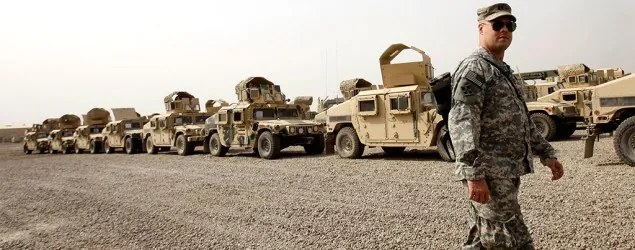

Where RFID fits in defence logistics
- Convoy and transit-point logging — UHF tags on vehicles are read automatically at check posts, time-stamping arrivals and departures and feeding movement data to central command over combined RFID and GPS links.
- Weapon and armoury management — uniquely identifiable RFID tags attached to weapons ensure they are issued only to authenticated personnel, with every issue and return on record.
- Ammunition and stores accounting — guns and ammunition held as stock keeping units are tracked as they transfer between units and destinations, so records stay current and accurate for strategic reasons.
- Vehicle and fuel management — tagging vehicles lets fuel limits be enforced with proper authorisation, and the same identity supports unit-specific POH and ROH maintenance schedules.
- Asset visibility across deployments — the wide variety of assets distributed across units, from vehicles to specialist equipment, can be audited in minutes instead of days.
Specialised field equipment
Beyond logistics, we provide intelligence and information-gathering kits in miniature form factors for covert operations. These kits use state-of-the-art technologies to log authentic information from sources, aided by the latest communication links. We also supply night vision devices for combat operations — ask our team for technical guidance on the various generations of these devices.
Recommended Identium hardware
- CX1500N handheld RFID reader — Android-based stocktakes of armouries, stores and vehicle parks in the field.
- HLR200 UHF gate reader — hands-free reading of tagged vehicles and material at check posts and depot gates.
- CR400 ceramic on-metal tag — a compact, rugged identity for weapons and metal equipment in harsh conditions.
- IHZ4 4-port fixed reader — covers armoury racks and issue counters with up to four antennas.
- UHF windshield tags — tamper-evident vehicle identification for automated gate movement.
Related solutions
- RFID weapon tracking management
- Weapon management
- RFID asset tracking
- Active RFID reader tracking for real-time location of high-value assets and personnel across large establishments.
Defence programmes demand discretion, documentation and hardware that survives the field — all three are Identium strengths. For a detailed discussion of total solutions for your formation or depot, talk to our team.
Specifying frequency, tags and build for defence logistics
Nearly everything above runs on passive UHF at 865–868 MHz, the band WPC notified as licence-exempt for RFID use in India under its Short Range Devices rules of 2021 (G.S.R. 853(E)) — the position as of 2026, and worth confirming against the current WPC notification before a specification is frozen; our BIS and WPC compliance guide sets out what to ask a supplier for. The application decides the frequency. A check post or depot gate has to identify many items at once, at a few metres, without presenting each one to a scanner: passive UHF — EPC Gen2, standardised as ISO/IEC 18000-63 and marketed as RAIN RFID — is the family that does that, because HF and LF are near-field technologies that read at centimetres. Which is exactly why HF at 13.56 MHz (ISO 14443 or ISO 15693) belongs on the personnel ID card at the armoury door, where a deliberate tap is the point, and does not belong on a stack of stores across a loading bay. Continuous live position, as opposed to a stamped record at a waypoint, is an active or BLE job rather than a passive one.
Matching the tag to the asset
| Asset class | Tag to specify | Attachment |
|---|---|---|
| Vehicles in convoy | Windshield tag on the screen; on-metal hard tag where there is no glass | Adhesive to the screen; rivet or epoxy on bodywork |
| Small arms | Compact ceramic or PPS on-metal tag | Epoxy, or cable-tie at the sling swivel |
| Ammunition and stores crates | ABS or PC hard tag, or a cable-tie tag | Rivet or cable-tie |
| Radios, optics, test sets | Small on-metal ABS or PCB tag | Adhesive or rivet |
| Cylinders, jerricans, tentage | Rugged sealed tag, epoxy-potted | Cable-tie or epoxy |
Field conditions decide the build as much as the electronics do. For units facing vibration, solvents, dust and wide temperature swings we ultrasonically weld or epoxy-pot the housing; TPU, silicone and nylon suit tags that must flex or sit against webbing. A laser-marked human-readable serial alongside the encoded EPC keeps a store-man working when a reader is down. Encoding, serialisation and artwork are done at our Delhi factory, with custom tags typically in 5–10 days, and units are tested in-house before dispatch.
Points a buyer can write into a specification: Identium is BIS certified, and our UHF readers and antennas are WPC-approved for India’s licence-exempt UHF RFID band — that is the position as of 2026, and our team can confirm current status for the specific models you are specifying. Every reader ships with an SDK, demo application and source code, so integration stays with your own team or integrator. Read ranges are typical rather than guaranteed — dense metal, stacked stores and tag size all cut them — so trial the tag on the actual asset before quantities are fixed.