

RFID in logistics and warehousing starts paying off from the very first transaction: the raw-material receipt. Whether or not incoming material is barcoded, goods receipt is where you verify items, quantities and ship dates against the terms agreed with your vendors. Once material is inwarded, the item and its location ID are scanned with a mobile computer before the stock is placed into the rack or bin — so the put-away location is captured, not guessed.
Dispatch: a pick list is generated and downloaded onto the RFID handheld reader. The picker keys in the vendor code to see the items to be packed, scans material and location codes, and transfers the goods for packing. When the bin is ready for dispatch it is scanned once more — confirming the load and triggering invoice generation.
Where RFID fits in logistics & warehousing
- Goods receipt verification — confirm every item, quantity and ship date at the inbound dock
- Put-away and bin management — scan material plus location so stock is always findable
- Picking and dispatch confirmation — handheld-guided pick lists with a final scan before invoicing
- Dock-door gate reading — read whole pallets and trolleys passing warehouse RFID gates without line of sight
- Pallet and crate tracking — reusable RFID pallet tags keep returnable assets circulating
- Shipment security — RFID cable-tie seals show whether cartons or containers were opened in transit
Advantages
- Enter and access real-time, accurate data right from the floor
- The entire process stays synchronised end to end
- Limited human interaction at every step
- Transactions move quickly and error-free from warehouse to ERP system
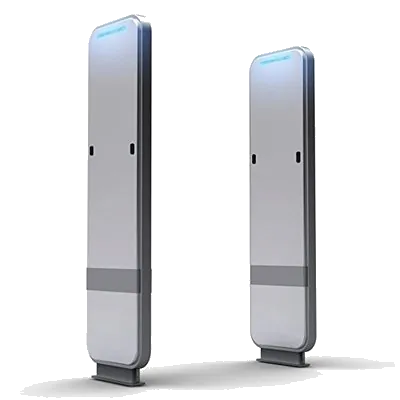
Recommended Identium hardware
- CX1500N handheld RFID reader — Android handheld for receiving, picking and cycle counts.
- UHF gate reader HLR200 — dock-door portal that logs every inbound and outbound movement.
- IHZ4 4-port fixed reader — warehouse RFID reader for conveyors and multi-antenna read points.
- RFID pallet tags — rugged tags for pallets, crates and returnable transport items; shop durable and rugged tags at our store.
Related solutions
- RFID warehouse management
- RFID inventory management
- RFID pallet tracking solution
- RFID supply chain management
Want error-free inbound and outbound logistics with live ERP sync? Talk to our team — we will map your receipt-to-dispatch flow and recommend the right tags and readers.
Choosing the frequency, the tagging level and the read zone
Warehouse and logistics RFID in India runs on passive UHF in the 865–868 MHz band — EPC Gen2, standardised as ISO/IEC 18000-63 and marketed as RAIN RFID. As of 2026 that band is reported as delicensed for RFID under India’s WPC rules; confirm the current position with WPC before you freeze a specification. UHF is the band to use here because it is the only one of the three common options that works at metres rather than centimetres: HF at 13.56 MHz and LF at 125/134 kHz read at centimetres, which is fine for a staff access card and no use at a dock door. Those two bands are not EPC Gen2 or RAIN RFID — both terms describe passive UHF only. Identium is BIS certified, and the UHF readers and antennas we supply are WPC-approved for the Indian band.
The first decision is not which reader to buy, but what you tag. The tagging level sets the tag construction, the attachment method and everything downstream of it.
| What gets tagged | Tag construction | Attachment | Trade-off |
|---|---|---|---|
| Cartons, cases, polybags | UHF label or inlay | Adhesive | Lowest cost per unit; typically best range on dry, non-metallic goods |
| Plastic pallets, crates, bins | Rugged ABS, PC or nylon hard tag | Rivet, cable tie or adhesive | Takes day-to-day handling in the aisle; sealed or epoxy-potted constructions for wet and harsh areas |
| Steel cages, metal trolleys, racking | On-metal (anti-metal) tag | Adhesive, rivet or epoxy | Range drops on metal — bring the read point closer in |
| Rack, bin and location IDs | Hard tag or on-metal tag | Rivet or adhesive | Read at arm’s length with a handheld, so placement and legibility matter more than range |
Read range is not a fixed figure. It depends on the tag, the antenna, the transmit power, what the goods are made of and what is standing around them. A tag on a plastic pallet will typically read several metres from a well-placed fixed antenna, less from a handheld, and less again on a steel cage or a carton of liquids. Metal racking also reflects RF, so a dock-door portal can pick up stock sitting in the next lane. Design for that rather than against it: set transmit power to the lane instead of to maximum, filter weak stray reads on RSSI, and sequence antennas or pair the portal with a sensor so an inbound read is not posted as a dispatch. Circular-polarised antennas generally suit dock doors where carton orientation varies; linear generally gives more reach where tags are consistently aligned, as on a conveyor.
Pilot one dock door and one aisle with your own stock before committing to a tag quantity. We test units in-house before dispatch, but the read zone is a property of your building, not of the tag — foil-lined packaging, liquids and steel shelving are what break a design, and they only show up on site.