
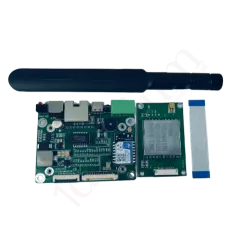
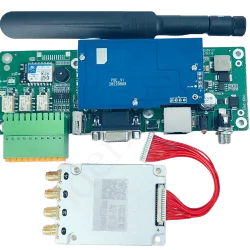
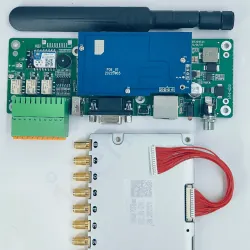
A UHF RFID reader module is the reader without the box: a board you build into your own kiosk, cabinet, barrier controller or automation panel. Identium supplies four for OEMs and integrators in India: the ICL1P, ICL4P and ICL8 Linux boards with one, four and eight antenna ports, and the IDTS-RM26, a single-port board with Ethernet, serial, Wiegand and a relay.
Board or finished reader?
With a board, the enclosure, antenna, cabling and power are yours to design, and so is the finished product’s approval.
A finished reader from our UHF RFID reader range arrives housed. The IHZ4 4-port fixed reader is a housed four-port alternative: an Impinj E710 reader in a die-cast aluminium housing with 4 × SMA ports, serial, Wiegand, Ethernet and relay outputs. The IHZ4 is BIS and WPC approved. Integrated readers put reader and antenna in one housing for doorways and parking lanes. The ID-EA500 edge array reader combines an E710 reader IC, a 12 dBi array and a Linux edge controller in one PoE ceiling panel.
UHF RFID reader modules at a glance
| Model | Antenna ports | Chip (as listed) | Host interfaces | Read range (as listed) |
|---|---|---|---|---|
| ICL1P | 1 | Impinj; part no. to be confirmed | Wi-Fi; Bluetooth, 4G optional | Up to 15 m |
| ICL4P | 4 | Impinj E710 (Gen2X support) | Wi-Fi, PoE; Bluetooth, 4G optional | Up to 20 m |
| ICL8 | 8 | Impinj E710 (Gen2X support) | Wi-Fi, PoE; Bluetooth, 4G optional | Up to 20 m |
| IDTS-RM26 | 1 × SMA female | K9 (vendor not stated) | Ethernet, RS232, RS485, Wiegand 26/34; relay | Not published |
Listed ranges depend on antenna, tag and site. The ICL boards are listed for the India band; the RM26 comes in an India version and a 902–928 MHz (US FCC band) version for export.
ICL1P, ICL4P and ICL8: Linux boards for networked read points
All three run Linux on an ARM9 CPU, are designed for continuous 24 × 365 operation and scan automatically, reporting over a COM port or the network.
On the ICL4P and ICL8 the ports are read in turn, as on our IHZ4 fixed reader, so plan read zones, not simultaneous readers. The ICL1P is listed at up to 400 reads per second and the ICL4P and ICL8 at up to 1,000, each a reader-level figure, shared across enabled ports, that depends on tag population and antenna layout. Ask us for the exact Impinj reader IC on the ICL1P in writing.
The ICL4P and ICL8 are listed with Impinj Gen2X support, which needs support in the tag IC as well as the reader IC. A Gen2X-enabled tag on an ordinary Gen2 reader should behave as an ordinary Gen2 tag, but confirm that in writing for the exact part and prove it on a sample lot; our Gen2X and Gen2v3 protocol guide explains what to test.
The ICL listings give no antenna connector type, RF output, supply voltage, dimensions, operating temperature or other-region variant; get these in writing before designing an enclosure.
IDTS-RM26: a Wiegand and relay board for barriers and gates
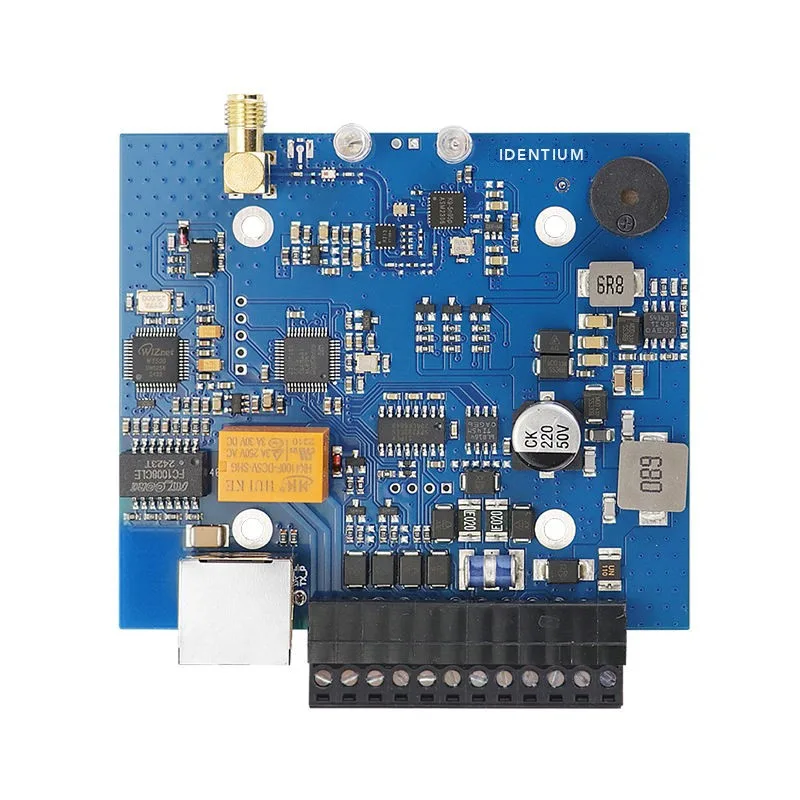
The IDTS-RM26 is a split reader module: one SMA female port, external UHF antenna. It reads and writes EPC Gen2 (ISO/IEC 18000-63, formerly 18000-6C) tags. Output is 0–26 dBm, adjustable, with FHSS or fixed-frequency operation. The RF chip is listed as K9 with no vendor stated; ask us for the vendor and part number if your design depends on it.
Alongside Ethernet, serial and Wiegand 26/34 output, its relay group (COM/NO/NC) can switch a barrier or gate. Work modes are listed as active, passive (command) and trigger, but the terminal lists no trigger input, so confirm how the trigger is fed.
Wiring is on a 12-pin, 3.81 mm terminal (power, RS232, RS485, Wiegand D0/D1, relay COM/NO/NC), and power is DC 9–24 V at up to 4 W. The board is about 87 × 85 × 16 mm, 50 g, with 3 mm mounting holes; confirm the dimensions and hole positions before tooling an enclosure. Operating temperature is −20 °C to +70 °C; −40 °C to +125 °C is storage only.
The listing names compatible third-party software; ask us which software comes with the board. It ships with one UHF test card and a factory QC certificate; antenna, cables and power supply are not included.
Prototype first: the RM26 evaluation kit
The RM26 evaluation kit is for prototyping a smart shelf, cabinet, drawer, gate controller or machine. Its contents are listed in the FAQ below; test your own tags on your own items before committing an enclosure.
Antennas, ports and cabling
Some of our antennas are built for the FCC 902–928 MHz band for export, so tell us the country of installation and we will quote the right variant. The RM26’s 26 dBm maximum is conducted power at the SMA port; e.r.p. is that plus antenna gain in dBi, minus 2.15 dB and cable loss. At 26 dBm into a 9 dBi antenna with no cable loss that is about 32.9 dBm (1.9 W), just inside the 2 W e.r.p. permitted on India’s four RFID channels, so a higher-gain antenna needs the output turned down. See our UHF RFID antenna range and antenna gain and polarisation guide.
India band rules and approvals
India’s licence-exempt UHF RFID band is 865–868 MHz under G.S.R. 853(E) of 10 December 2021. Table IV permits 2 W e.r.p. only in four channels of up to 200 kHz centred at 865.7, 866.3, 866.9 and 867.5 MHz, with continuous transmission on a channel limited to 4 s and at least 100 ms before the interrogator transmits on that channel again. Configure output and hopping on whichever board you use within those limits.
A product built around one of these boards is a model of its own: plan for Equipment Type Approval of that product, and confirm the route with WPC (and BIS, where your product category requires it) before you ship. Identium is a BIS and WPC approved RFID manufacturer, and our BIS and WPC buyer’s guide covers what to ask any supplier.
Software: SDKs, and where ReaderSense fits
Each module is listed with an SDK, for all common programming languages on the ICL boards; plan on it. ReaderSense is Identium’s free desktop app for Identium UHF readers, but no module listing names it, so ask us in writing before planning around it for any board. To filter reads and post them into an ERP or WMS, see our RFID software and middleware.
Choosing and ordering
- One antenna in a kiosk or cabinet: ICL1P.
- A gate or dock door you build yourself: ICL4P.
- Many antennas on one controller: ICL8.
- A barrier that needs Wiegand and a relay: IDTS-RM26, after a bench trial with the RM26 kit.
For a quote, send the board and port count, antennas and cable run per port, host interface, power source, enclosure and environment, and country of installation. Modules are quoted against specification. Browse the store’s RFID modules category, then send us your specification.