
On this page, a high-temperature RFID tag means a UHF tag whose body is specified for heat, so the skid, mould, fixture or part it rides on keeps its identity through a hot process. It identifies the item; it does not measure temperature, which is the job of RFID temperature sensor tags. Below, five store listings are compared using only the figures each one states, with the ceramic CR400 as the cool-side reference.
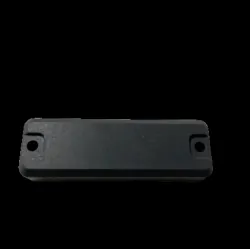
Survival temperature is not read temperature
The specs use three labels. Operating is the range a listing labels as operating; it does not confirm that the tag was read at the upper figure. Storage is the range for holding the tag unused, and ambient the temperature of the surroundings the body is listed to tolerate. An ambient figure alone says nothing about whether the tag works at that temperature.
The Cera-9 shows the gap: operating −30 °C to +85 °C, ambient −30 °C to +250 °C, so any read waits until it has cooled.
The IDTS-UMHT lists continuous operation from −25 °C to +200 °C and short exposure to +275 °C for 30 minutes, which its summary describes as survival rather than operation. It is the only peak among the five with a duration attached. Its storage ceiling (+100 °C) sits below its operating ceiling, so confirm both figures before ordering.
The rule: plan every read outside the hot zone.
Five tags compared, as each listing states them
| Model | Temperature (listing’s label) | Read range | Mounting | IP |
|---|---|---|---|---|
| Steelcode | Ambient −30 to +300 °C only | Up to 6.5 m, on metal | Epoxy, or rivet (Ø 3.4 mm hole) | Not stated |
| IDTS-UMHT | Operating −25 to +200 °C, continuous Short exposure to +275 °C for 30 min (survival, not a read condition) Storage −25 to +100 °C | Up to 15 m, fixed UHF reader | Not stated | IP68 |
| Cera-9 | Operating −30 to +85 °C Ambient −30 to +250 °C | Not stated | Epoxy | IP68 |
| IDTS-MPT18 | Operating −40 to +250 °C Storage −45 to +250 °C | Up to 6 m, reader dependent (surface not stated); listed as reading on metal | Adhesive or embedded | Not stated |
| CR400 (reference) | Operating −40 to +100 °C Storage −40 to +150 °C | Up to 2.0 m fixed, 1.0 m handheld, on metal | Adhesive backing | IP68 |
Size, chip and band
| Model | Size; body | Chip | Frequency |
|---|---|---|---|
| Steelcode | 13 × 38 × 7.7 mm Ceramic, PA6+GF surface | Impinj R6-P | India’s UHF band (listing text, not spec table) |
| IDTS-UMHT | 60 × 19 × 10 mm High-temperature plastic | Alien Higgs 9 | 840–960 MHz chip span; covers India’s 865–868 MHz band |
| Cera-9 | 9 × 13.5 × 6 mm Ceramic, PA6+GF plastic | Not stated | UHF; band not stated |
| IDTS-MPT18 | 18 × 18 × 2.5 mm Ceramic | Impinj Monza 4QT (M4QT) | Listed bands: ETSI/India, FCC 902–928 MHz, 950–956 MHz |
| CR400 | 10 × 5 × 3 mm Ceramic | Alien Higgs-3 | Listed bands: India, US 902–928 MHz |
The UMHT’s 840–960 MHz is the chip’s global tuning span, not a licence. The IDTS-MPT18 and CR400 spec tables name EPC Class 1 Gen 2, and the Steelcode listing’s text calls its R6-P chip EPC Gen2; the IDTS-UMHT and Cera-9 listings name no protocol.
Where the read happens
Put one read point before the oven, booth or press and one after the cool-down, never inside. Set the software to expect no reads between those two points.
Where you can, tag the returnable item rather than the part: the skid, hanger, mould frame or tray. A skid’s tag stays with it across cycles; it normally carries a serial, not the VIN, and the MES maps that serial to whichever body is on the skid. RFID for automotive covers skid reads, PLC integration and overspray on carrier tags; choose the tag itself from the tables above. Manufacturing WIP tracking gives the two usual answers to a hot process: tag the part after it, or keep the tag on a fixture or carrier that never enters the oven and let the ERP hold the link to the part.
Mounting often gives way first
A tag body rated for the heat does not help if its fixing lets go. Each listing names its own fixing (see the first table), except the IDTS-UMHT, which states none.
No listing gives a temperature rating for its epoxy, adhesive or embedded fixing, so compare any rating you obtain with the temperature at your mounting point. Weld studs, bolts and brackets are questions to put to Identium; none of the five listings offers them.
Rugged RFID tags explains why an IP rating says nothing about sustained heat, and the on-metal tag range covers why a tag on steel needs a spacer and ground plane.
Matching a tag to the process
The Steelcode listing names paint-shop jigs, heat-treatment fixtures and foundry tooling among its applications, the IDTS-UMHT listing mentions parts that pass through an oven or a curing step, and the IDTS-MPT18 listing raises autoclaving only to advise testing a sample. None gives a process temperature or dwell time for those uses. Measure the peak temperature at the mounting point and how long it lasts, then compare both with each tag’s figures in the tables:
- Paint-shop and powder-coat carriers. Measure against the IDTS-UMHT (a continuous figure plus a 30-minute peak) and the Steelcode (an ambient figure, with a rivet option).
- Tyre curing moulds and containers. Tag the mould as an asset at a point whose temperature you have measured, not at its hottest spot. Tags for the tyre itself are a separate product: see RFID tyre tags and RFID for tyre manufacture.
- Foundry tooling. Tag the pattern plate or the flask, never the casting.
- Sterilisation trays. The IDTS-MPT18 is listed for surgical equipment, but no listing gives an autoclave, steam or pressure rating, so trial any candidate on your own cycle.
- Structural steel through ovens. Shot blasting, galvanising and paint ovens can destroy an ordinary tag, so fit tags after surface treatment or recess them into a bracket, as set out for RFID in steel and infrastructure.
Ceramic does not automatically mean high-temperature
The CR400 is ceramic and IP68, yet it is specified for operation only to +100 °C (see the table). That suits a tool, mould or component whose mounting point stays cool, not a position that passes through an oven. The IDTS-UMHT runs the other way: a plastic body listed for +200 °C continuous operation. The specified figures decide, not the body material. The full specification is on the CR400 ceramic on-metal tag page.
Choosing and ordering
Identium Tech Solutions is an RFID manufacturer in New Delhi. To shortlist a tag for a hot process, send:
- peak temperature at the mounting point, and dwell time at that peak
- cycles per day, and how the item cools down
- surface material and the fixings you are allowed to use
- where the read happens, and at what distance
- quantity
In return, ask for written confirmation of anything the tables mark “not stated”, the temperature rating of the fixing, and the band each tag is tuned for.
Tags are quoted against specification, and custom tag orders typically turn around in 5–10 days. Store listings: Steelcode, IDTS-UMHT, Cera-9 miniature ceramic tag, IDTS-MPT18 and CR400.
Passive tags have no transmitter and need no WPC approval and no BIS registration. For materials, ask for the SKU’s material-compliance declaration in writing. Send your process details to Identium.