
An RFID tag for gas cylinders is a passive UHF (EPC Gen2) on-metal tag that identifies an LPG, industrial-gas or medical-oxygen cylinder at each fill, dispatch, return and audit. For Indian use it should be tuned for India’s 865–868 MHz band. Identium designs and manufactures UHF tags, on-metal tags and UHF readers in New Delhi. Choosing an LPG cylinder RFID tag comes down to three questions: where it sits, what it stores and where it is read.
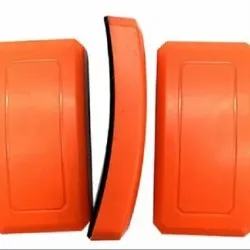
Why a cylinder is a hard surface for a UHF tag
The body is curved metal, usually steel, which detunes an ordinary UHF antenna, and dense stacks shadow the tag. Design for one cylinder at a time, not a full cage in one pass. Detuning and spacer design are covered on our on-metal RFID tags page and in why ordinary RFID labels fail on metal.
Where the tag goes on the cylinder
- Valve guard. Off the pressure shell, away from any stripping and repainting. A bolted on-metal bar such as the IDTS-7020 avoids adhesive. A standard cable-tie tag is not an on-metal design, so if the guard only takes a tie, ask us whether the UHF variant reads on it.
- Collar or neck ring. Also off the shell. No collar tag is listed; send us the neck and guard geometry and ask whether one can be made.
- Valve body or fitting. A small ceramic tag, bonded or epoxied to a flat face.
- Shoulder. The largest surface, but steel cylinders are often stripped and repainted at periodic test, so plan to re-tag after each test.
Use the same position on every cylinder. Fixing into the pressure shell itself is the cylinder owner’s engineering decision.
Five cylinder-tag options compared
Build, fixing and position (as listed)
| Model | Build | Fixing | Operating temp. | Position |
|---|---|---|---|---|
| CY3 | ABS, shaped for curves | Not listed | Not listed | Curved guard |
| IDTS-7020 | 70 × 20 × 3 mm PCB | 2 bolt holes, 64 mm centres | −20 to +150 °C | Guard or bracket |
| CR400 | 10 × 5 × 3 mm ceramic | Adhesive | −40 to +100 °C | Flat valve face |
| Cera-9 | 9 × 13.5 × 6 mm ceramic | Epoxy | −30 to +85 °C | Valve or fitting |
| IDTS-UMHT | 60 × 19 × 10 mm, 9.0 g | Not listed | −25 to +200 °C continuous | Guard or bracket, heat step only |
Chip, memory and range (as listed)
| Model | Chip | User memory | Read range |
|---|---|---|---|
| CY3 | Not listed | Rewritable, size not listed | Not listed |
| IDTS-7020 | R3-P (as listed; confirm) | 32 bits | Approx. 6 m on metal, reader dependent |
| CR400 | Alien Higgs-3 | 512 bits | 2.0 m fixed, 1.0 m handheld, on metal |
| Cera-9 | Not listed | Not listed | Not listed |
| IDTS-UMHT | Alien Higgs 9 | 512 bits as listed; confirm the memory map | Up to 15 m, fixed reader |
All five are UHF. The CY3 and CR400 listings name India’s band; the IDTS-7020 (860–960 MHz) and IDTS-UMHT (840–960 MHz) give the chip’s global tuning span, which covers it but is not a licence; the Cera-9 names no band, so confirm it. The CR400, Cera-9 and IDTS-UMHT are listed as IP68. Ranges are listing figures; read-test your own cylinders.
Give the rigid CR400 ceramic on-metal tag a flat face. The IDTS-UMHT also lists survival at +275 °C for up to 30 minutes, an exposure limit, not a reading condition; specify it, or another of our high-temperature RFID tags, only where a heat step applies.
What to write on the tag and what to keep in software
Encode the cylinder serial in the EPC as the lookup key, and record the TID at commissioning. A serialised TID is factory-programmed and locked, so a known EPC read with an unrecorded TID is an unlogged replacement or a copied EPC; hold that cylinder until checked. Ask which SKUs carry a serialised TID.
User memory carries what a filling plant or delivery crew must check with no network. A workable layout stores dates as 16-bit day counts: owner code 16 bits, gas service 8 bits, last hydro-test date 16 bits, next test due 16 bits and test-station code 16 bits, 72 bits in all.
- CR400: 512 bits (64 bytes), most of it spare.
- IDTS-UMHT: listed as 512 bits, but its Higgs 9 chip trades user memory for a longer EPC; confirm the map for your EPC length.
- IDTS-7020: 32 bits, enough for gas service plus next test due.
- CY3 and Cera-9: not listed; ask for the memory map.
Keep the fill-cycle log in software against the EPC: it soon outgrows 64 bytes, and a damaged tag loses any on-tag history. Write to the tag only when a record changes, such as after a test.
Read points and the reader for each
A phone’s NFC works at HF 13.56 MHz and cannot read a UHF tag, so each read point needs a UHF reader.
- Filling line. For non-flammable gases, read cylinders in single file so each fill ties to one serial; for LPG, only where the premises’ licence and area classification allow. An IHZ4 four-port reader with antennas powered down to the lane can light a stop lamp from a relay output when software flags a cylinder past its test date.
- Dispatch and return gate. The HLR200 walk-through portal senses In/Out direction, separating outgoing from returning cylinders. A loaded cage reads poorly in one pass, so reconcile against the filling log and check exceptions by handheld.
- Hospital oxygen store. The CX1500N UHF handheld reader at reduced power, which narrows the read towards the cylinder in front; test it on your own stack.
The CX1500N’s SDK and the IHZ4’s APIs push reads into your ERP or asset register. Keep a printed serial as the manual fallback. Our RFID gate reader page compares a portal with a fixed reader.
For LPG and other flammable gases, the Gas Cylinders Rules, 2016 require electrical equipment in premises that fill or store gas cylinders to follow the IEC or IS/IEC 60079 series (rule 22, as substituted on 11 April 2025), and rule 14(2) bars mobile phones where such cylinders are filled, stored or handled. Identium readers are not offered as intrinsically safe or Ex-certified, so agree any fixed read point or handheld use there with the licensee and the licensing authority first.
Approvals and rules, briefly
These passive tags have no transmitter, so they need no WPC approval and no BIS registration; approval sits with the reader, and Identium is a BIS and WPC approved RFID manufacturer. No PESO approval or Ex certification is claimed for any of these tags; for a classified area, ask for the tag’s hazardous-area documentation in writing.
On marking, the Gas Cylinders Rules, 2016, as amended by G.S.R. 225(E) of 11 April 2025 (the Gas Cylinders (Amendment) Rules, 2025), require cylinders for compressed gases and liquids to carry a permanent, tamper-proof bar code marking, and define a bar code to include RFID and QR codes. An RFID tag is one permitted form; confirm with your licensing authority that your scheme is accepted. For detail, read the India RFID Store guide to gas cylinder tracking and the PESO rules and check it against that amendment and PESO’s Gas Cylinder Rules page. For the plant side, see RFID for oil and gas.
Choosing and ordering
For a quote, send:
- cylinder type and gas service
- mounting position, with guard, collar or neck geometry
- quantity
- data fields and numbering scheme
- read points
- any heat process the tag must pass through, with temperature and duration
Tags are quoted against specification; custom tag orders typically turn around in 5–10 days. A collar housing, if one can be made, is quoted separately. Send us your cylinder specification.