


RFID for infrastructure projects gives every steel member, prefab panel and engineered component a unique, scannable identity from the fabrication shop to final erection. It helps project teams monitor these components, and helps authorities inspect and focus on the critical stages of construction — the stages where structures undergo enormous stresses.
When you engineer complex mechanical structures serving varied purposes — from roller coasters to the underlying skeletons of skyscrapers and nested stadiums — every component is critical. Prefab engineered materials can be assembled with ease and speed once each part is uniquely identified at site. From design through the fast assembly and erection of warehouses, scaffolding, steel structures, complex roof structures and stadia, part and component identification ensures a perfect installation the first time.
Where RFID fits in infrastructure and steel construction
- Prefab component identification — prefab metallic panels, frames and doors carry our custom-built metal mount tags, so crews match each piece to the drawing and assemble in the correct sequence on site.
- Inspection and stress-stage records — scanning a tagged member at each critical construction stage creates a time-stamped trail that engineers and inspecting authorities can rely on.
- Steel yard and laydown management — locate fabricated members in congested storage yards before crane time is booked, instead of searching bay by bay.
- Erection progress tracking — as tagged components go up, site dashboards reflect true installed status for warehouses, roof structures and stadia.
- Tools, plant and site equipment — the same readers extend to scaffolding components, lifting gear and tools moving between stores and work fronts.
- Material movement at site gates — gate-level reads log what entered and left the site, supporting reconciliation between fabricator, transporter and contractor.
Recommended Identium hardware
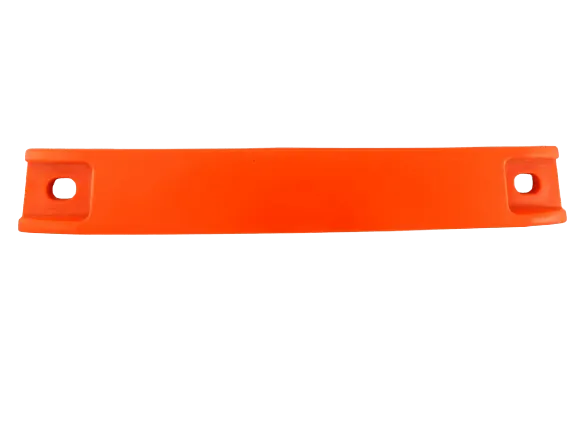
- UHF RFID metal tags — metal mount tags engineered for steel surfaces, including custom builds for prefab panels, frames and doors.
- CR400 ceramic on-metal tag — a compact ceramic tag for structural steel exposed to rough handling and weather.
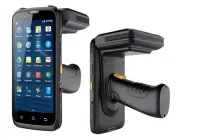
- CX1500N handheld RFID reader — verify components at receipt and before erection, anywhere on site.
- HLR200 UHF gate reader — automatic logging of tagged material crossing site gates.
Related solutions
- RFID asset tracking
- RFID tool tracking
- Manufacturing & WIP tracking for fabrication shops feeding your sites.
- Active RFID reader tracking for real-time location of high-value plant across large construction sites.
Contact us today for cost-effective solutions to identify prefab structures and keep your erection schedule on track — talk to our team.
Specifying RFID for structural steel: frequency, mounting and encoding
The frequency decision is settled by distance. Of the passive options, only UHF reads a member from metres away rather than centimetres, which puts structural steel squarely in passive UHF territory: EPC Gen2 tags, standardised as ISO/IEC 18000-63 and marketed as RAIN RFID. In India that runs on the 865-868 MHz band, which WPC delicenses for RFID — the position as of 2026, and worth checking against the current WPC notification before you write it into a specification. Identium’s UHF readers and antennas are WPC-approved for India’s licence-exempt UHF RFID band. HF at 13.56 MHz and NFC are contact-range technologies and are not EPC Gen2 or RAIN RFID at all; they earn a place only where an inspector will deliberately hold a phone against each member, never for yard search or gate reads.
The harder question is where in the fabrication sequence the tag goes on. Shot blasting, hot-dip galvanising and paint ovens will destroy or badly degrade an ordinary tag, so fit tags after surface treatment — or design in a small bracket, fixed at the end of the fabrication line, that the tag then recesses into. Plain labels also detune badly against steel, which is why every tag on a member should be an on-metal type: the spacer and ground plane behind the antenna are what stop the steel swallowing the signal. For members that will sit outdoors for months or take knocks in a laydown yard, ask about ultrasonic welding or epoxy potting of the housing.
| What you are tagging | Identium tag | Read-range expectation (environment-dependent) | Attachment |
|---|---|---|---|
| Beams, columns, trusses | UMMGT metal mount, 177 x 25 x 12 mm | The longest reach in the on-metal family; at best on the order of 10-15 m from a fixed reader in clear air, and far less across a dense stack | Rivet, bracket or epoxy |
| Prefab panels, frames, doors | MNTH3 nano metal tag, 38.5 x 14 x 3.5 mm, where the profile must stay flush — or a custom metal-mount build | A few metres on a handheld walk-past | Adhesive or rivet |
| Moulds, dies, fittings, small brackets | CR400 ceramic, 10 x 5 x 3 mm | Around 2 m fixed and 1 m handheld on metal; small antennas trade range for size | Adhesive or epoxy |
| Scaffolding tube, couplers, lifting gear | UMT60, 60 x 19 x 7 mm | A couple of metres, and very sensitive to how tightly the tube is stacked | Adhesive, rivet or cable tie |
| Rebar bundles, consignment and sample seals | ID7 cable-tie tag, 300-380 mm tie | A few metres in open air | Self-locking tie, single use by design |
Treat every figure above as a starting point rather than a guarantee. Read range on steel depends on tag orientation, what else is stacked around the member, reader power and antenna choice, so prove the combination on your own material before you commit to a design. Specify the UHF variant explicitly, too: several of these housings are also built in HF or NFC, which is a different technology with centimetre range and none of the gate-reading behaviour you are designing for.
Encode the fabricator’s piece mark into the EPC so the tag matches the erection drawing, and on chips that carry user memory, keep that block for the heat number or drawing revision. Ask for the same piece mark laser-marked or printed on the tag face as well, so the member is still identifiable when a tag is damaged — customised runs of this kind are typically a 5-10 day turnaround. At the site gate, use circular-polarised antennas, because members arrive at whatever angle the trailer was loaded at. Avoid mounting inside deep channels or box sections, where the steel shields the tag; the outer face, set back from the edge, reads best.