
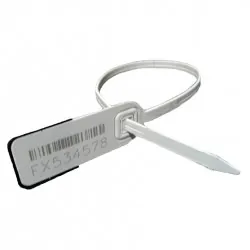
An RFID seal tag closes a door, bag or cage once and carries a chip that a reader can log, so the same part shows physical tampering and identifies itself. This page covers the ID4 cable seal from Identium Tech Solutions, an RFID manufacturer in East of Kailash, New Delhi, and compares it with four other tamper-evident tags. It also sets out where a commercial seal ends and a customs e-seal begins.
What an RFID seal tag does, and what the chip does not
A seal tag does two jobs. The one-time body carries the tamper evidence: opening it leaves a cut or broken seal that anyone can see. The chip carries an ID that a reader can capture and a system can log. The ID4 cable seal listing describes no electronic tamper detection, so treat the chip as identity, not as an alarm.
A swapped seal can look intact, so the two jobs work only through a seal register:
- At sealing, record the printed seal number, the chip read, the load or asset it closes, who fitted it and when.
- At opening, read the seal before it is cut and check both identifiers against the register.
A cut body, or a read that does not match the register, is the evidence. RFID for transportation uses the same discipline at dispatch and delivery.
ID4 cable seal specification
From the ID4 cable seal store listing:
- Construction: polypropylene (PP) strap and housing, tamper-evident
- Frequency: 13.56 MHz (HF) or UHF
- Chip options: HF S50 or NTAG21x; UHF Alien Higgs-3 (H3) or Impinj Monza R6 (MR6).
- Numbering: up to 7 digits
- Barcode: Interleaved 2 of 5 or Code 128; others on request
- Marking: foil print, direct laser marking or thermal transfer
- Colour: white, yellow, blue or green for the laser-marked version; others on request
The listing gives no read range, IP or temperature rating, memory size or UHF tuning.
Five ways a tag shows tampering
On all of these the evidence is physical and the chip read confirms identity; only the windshield label is listed as breaking on removal.
| Model | Form and size | Chip (as listed) | Frequency (as listed) | How tampering shows | Read range (as listed) | Used for |
|---|---|---|---|---|---|---|
| RFID Cable Seal Tag ID4 | PP strap seal | HF: S50, NTAG21x; UHF: Alien Higgs-3 (H3), Impinj Monza R6 (MR6) | 13.56 MHz (HF) or UHF; UHF tuning not listed | One-time strap body shows a cut or opening | Not listed; reader-dependent | Containers, truck doors, cash bags, meters, warehouse cages |
| RFID Cable Tie Tag (also coded ID4) | UV-resistant nylon PA66 tie, IP67; 150, 200 or 300 mm | Not named on the listing | 865–868 MHz (India UHF band), EPC Gen2 / ISO 18000-6C | One-way ratchet closure (listed as tamper-evident) | 0.5–2 m; reader-dependent | Cables, pipes, hoses, conduits, bundles |
| IDTS-UTWTH3 | Flexible self-adhesive windshield label | Not named on the listing | UHF; protocol and tuning not listed | Breaks on removal; cannot be removed and refitted intact | Over 8–10 m when fixed inside the windshield; reader-dependent | Vehicle identification at a boom barrier |
| ID-4320-FM13HS01 | Fragile label, 43 × 20 mm antenna on a 50 × 25 mm die-cut | FM13HS01-P, 896 bits | 13.56 MHz (HF/NFC), NFC Forum Type 5 / ISO/IEC 15693 | Fragile build: a peel-and-reuse attempt shows | Up to 0.2 m; reader-dependent | Cartons, closures, high-value products |
| P01 | PVC wristband | Customised on request | HF (13.56 MHz) or UHF; UHF tuning not listed | Single-use closure: cannot move to another wearer unnoticed | Not listed | Paid admission, crowd control, patient identification |
Where a listing says only “UHF”, ask for written confirmation of the tuning supplied and that it suits India’s licence-exempt UHF RFID band. For the vehicle and wearer formats, see RFID windshield tags and RFID wristbands.
Where seal tags are used
The ID4 cable seal listing names containers, truck doors, cash bags, meters and warehouse cages:
- Loads between sites. Truck doors and containers on domestic movements are sealed at dispatch and checked at receipt (export containers under customs self-sealing need a bolt e-seal; see below). Each handover is a read point in RFID supply chain management.
- Cash bags. Closed at one counter and opened at another, where a close-range HF check suits.
- Meters and warehouse cages. An opening shows at the next inspection; log the seal against the asset in your RFID asset tracking register.
- Bonded warehouse doors and cages. A numbered one-time seal gives the keeper a physical record to set against the electronic one; the store’s guide to the draft Warehousing Operations Regulations 2026 covers the customs side.
- Stores crates. RFID in defence logistics lists a cable-tie tag for ammunition and stores crates; where each opening must be numbered and logged, a seal fits better.
The RFID cable tie tag is tamper-evident too, through a one-way ratchet, but it is a nylon PA66 tie with a UHF inlay, made to stay on cables, pipes, hoses or bundles. Choose the ID4 cable seal when each closure needs its own printed number and barcode and an entry in a seal register.
Export containers: a customs e-seal is a different product
Under the specification CBEC (now CBIC) set in Circular 36/2017-Customs of 28 August 2017, as restated in JNCH Public Notice 120/2017, an exporter self-sealing a container uses an “RFID tamper proof one time bolt seal”. The seal has to conform to ISO 17712:2013 (H) and ISO/IEC 18000-6 Class 1 Gen 2 (now ISO/IEC 18000-63) and is read with UHF reader-scanners, so a customs e-seal is passive UHF; an HF seal cannot be one.
The exporter declares the seal’s serial number on the shipping bill, and a tampered seal triggers mandatory examination (JNCH Public Notice 120/2017, paras 4(c) and 4(e)). Under the 2017 procedure, a Customs Officer at the port or ICD checked seal integrity with reader-scanners linked to the vendor’s data retrieval system (JNCH Public Notice 120/2017, para 6(d)). Since 7 August 2025, JNPA’s Centralised Parking Plaza has checked e-seals at its entry gate with a universal reader integrated with ICEGATE, and its gate-entry receipt now serves as confirmation that the seal was verified (JNCH Public Notice 65/2025).
The ID4 cable seal is a polypropylene strap seal. It carries no ISO 17712 classification and is not documented as meeting the customs e-seal specification, so it is not a substitute for an ISO 17712 (H) bolt e-seal in customs self-sealing. For the current customs position, see the store’s guide to RFID e-seals for export containers in India.
HF or UHF, and how the seal gets read
HF (13.56 MHz) suits a deliberate, close-range check: the operator brings the reader to the seal. A phone’s NFC works only with HF chips, never UHF, and not every phone reads every HF chip type (the S50 option in particular); test your phone with the chip option ordered before relying on it.
UHF is the option to trial where the seal must be read at a gate, at a dock door or with a handheld, without bringing the reader to the seal. For India’s licence-exempt UHF RFID band and channel plan, see RFID frequencies; for other passive UHF formats, see UHF RFID tags.
Approval sits with the reader, not the passive seal, and Identium is a BIS and WPC approved RFID manufacturer. For handheld reads, see the CX1500N handheld reader.
Choosing and ordering
To specify ID4 cable seals, send:
- The use and the read point: counter, gate, dock or handheld.
- HF or UHF, and the chip option from the list above.
- The numbering scheme (up to 7 digits) and the barcode symbology.
- The marking method and the colour.
The store’s cable tie tag also carries the model code ID4, so quote the cable seal listing in your enquiry. Pricing is quoted against specification on the ID4 cable seal listing, and custom tag orders typically turn around in 5–10 days. Send the specification through the contact page.