
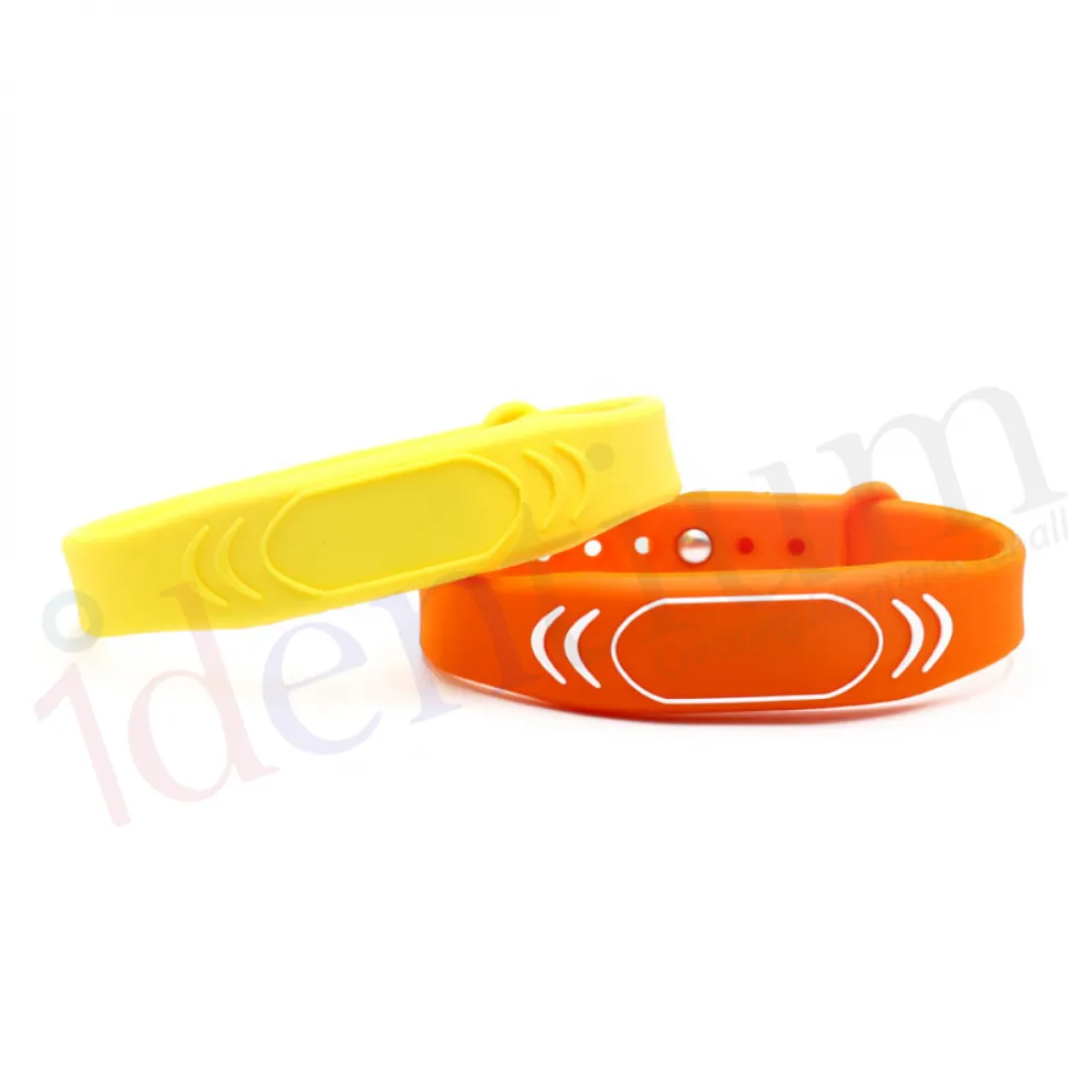
The C07 is the best-selling wristband in our current range — a reusable, adjustable RFID wristband made from silicone with a PVC strap section, sized to fit children, women and men on the same stock. One SKU for every wrist keeps procurement simple for gyms, water parks and hospitals, and because the band is reusable it pays for itself across hundreds of member visits. It can be supplied with an LF, HF/NFC or UHF chip depending on whether you need short-range tap access or long-range hands-free identification.
Key specifications
- Construction: reusable silicone and PVC wristband with adjustable closure
- One size adjusts across child and adult wrists; custom sizing available
- Frequency options and typical read range: LF 0-5 cm, HF 0-5 cm, UHF up to 7 m
- Customisation: band colour, printed logo and text, QR code, barcode, serial numbering, embossed or debossed finish, and laser-marked numbers
- Suited to wet areas — widely used at swimming pools, saunas and cold storage facilities
Applications
- Gym, spa and swimming pool member access and locker linking
- Cashless payment and tap-to-pay at clubs, water parks and events
- Patient identification in hospitals
- Staff identification in cold storage and food processing areas
- General access control and secure data transfer applications
<!— seo-expansion-thin2 —>
How to specify a C07 so it works with the readers you already own
Everything visible on a C07 can be changed late — colour, logo, numbering. The band it answers on cannot. Match that to the readers already installed on your site before anything is printed, because a batch can arrive correct in every visible respect and still be ignored at the door.
| What the band has to do | Band to specify | What that gives you |
|---|---|---|
| Locker opening, member tap-in, cashless spend, bedside patient check | HF 13.56 MHz (ISO/IEC 14443 or 15693; NFC sits here) | A deliberate tap at 0-5 cm, barely affected by the wearer |
| Matching 125 kHz proximity cards already issued on site | LF 125 kHz | 0-5 cm, and typically a unique ID only, with no application data to encode |
| Hands-free identification across an entry lane | Passive UHF — EPC Gen2 / ISO/IEC 18000-63 / RAIN RFID, 865-868 MHz in India | Range in metres rather than centimetres |
Two mismatches tend to surface late. A UHF C07 will not open our RFID locker locks, which read 13.56 MHz and 125 kHz — a different radio and a different protocol — and it will not tap at an HF cashless till either. Where gates run on UHF and lockers on HF, raise it in writing at enquiry rather than assuming one band covers both. And 13.56 MHz is not a single chip: the Mifare, DESFire and ISO/IEC 15693 families all sit on that frequency and answer differently, so name the chip your readers already accept — or send us one of the cards they accept — and have compatibility confirmed against your specification before a batch is approved.
Reading the up-to-7 m UHF figure correctly
The up-to-7 m range quoted for the UHF option is a typical free-air best case, and a worn wristband is never in free air. Human tissue holds a great deal of water, which absorbs UHF energy and detunes a tag’s antenna, so the same chip reads shorter on a wrist than on a desk, and worst of all with the arm between band and reader. Treat the figure as environment-dependent: design lanes so the wrist can be held clear of the body, and prove the distance you actually need at your own gate, with your own antenna position, before it goes into a specification. The 0-5 cm quoted for the HF and LF options is the steadier number because short-range coupling has far less to go wrong.
If you choose the UHF option, the radio rules matter. India’s licence-exempt UHF RFID band is 865-868 MHz under G.S.R. 853(E) of 10 December 2021, which superseded the 2005 rules that set 865-867 MHz. Identium is BIS certified, and our UHF readers and antennas are WPC-approved for India’s licence-exempt UHF RFID band. Treat that as orientation rather than clearance: if a figure is going into a tender or an import file, confirm the current position with WPC or BIS, starting from our BIS and WPC guide.
For a quote that lands right first time, send quantity, the band and chip family — or a sample of the card your readers already accept — band colours, artwork and your numbering scheme. Printing, serial numbering and laser marking are applied during manufacture, so settle artwork and numbering before the sample is approved.
Related reading
- UHF, HF and NFC frequencies compared
- Scoping read range against the real environment
- Buyer’s guide to RFID wristbands for events and festivals
Pair the C07 with our RFID locks for a complete locker system, or with our desktop readers for front-desk issuance. We manufacture wristbands in India with an in-house design team, so printed samples can be approved before bulk production — see the full RFID wristbands range for disposable Tyvek, fabric and PVC alternatives. Request a quote with your quantity and branding, or buy online at India RFID Store.
Who buys the C07 in India
Gyms, water parks and hospitals are the typical buyers of the C07 — the best-selling wristband in Identium’s current range — usually searching for a silicone RFID wristband price in India that covers one reusable band for every wrist. Because a single adjustable SKU fits children and adults, membership desks avoid stocking multiple sizes, and the silicone-and-PVC build handles pool, sauna and cold-storage duty. Clubs and event operators typically fit the HF/NFC version for cashless payments and tap-to-pay, while hospitals use printed, serial-numbered bands for patient identification. Facilities that need hands-free, longer-range identification choose the UHF option with up to 7 m read range. For high-volume festival programmes, compare it with disposable alternatives via our event wristband range, and request a manufacturer quote with your quantity and branding.