

We have developed an NFC-based cashless payments platform — a closed-loop prepaid wallet built to promote cashless transactions in canteens, educational institutions, hospitals, gyms, hotels and amusement parks.
The NFC platform integrates seamlessly with the access control module, so the same contactless NFC card that pays for lunch also opens the doors it should. We offer it as a monthly service-based model hosted on the cloud or as a complete enterprise software package to suit your requirement, with Android and iOS apps included as an add-on feature of the monthly model.
How it works
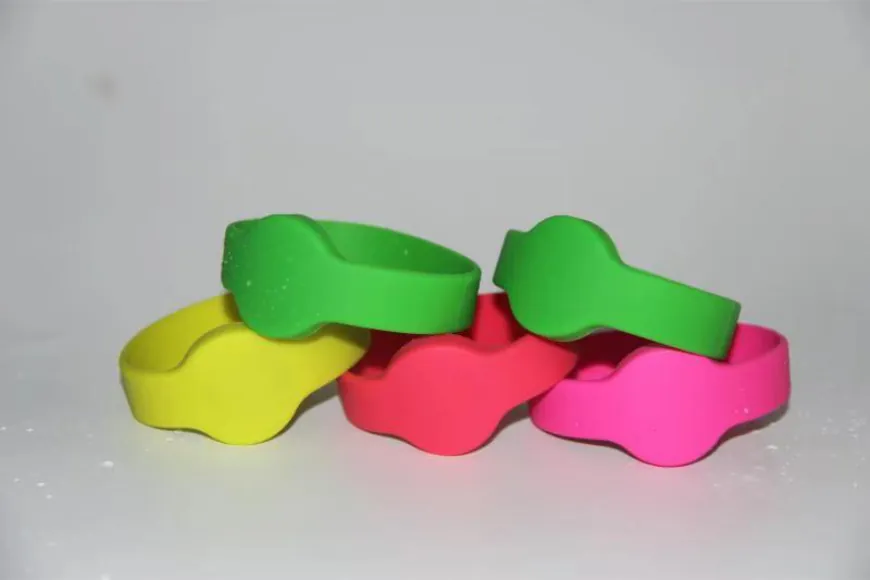
One contactless credential — an NFC card for a canteen or hospital, a silicone wristband for a festival or amusement park — carries both the guest’s identity and their prepaid balance:
Issue
Members or guests pick up their NFC card or wristband at reception, the school office or the entry gate; value is loaded at a top-up counter or through the companion app.
Tap
At the canteen till, tuck shop, ride entry or spa counter the guest simply taps to pay — and the same tap opens doors, since the wallet and access-control module share one credential.
Reconcile
Every transaction lands in the central wallet platform: a clean ledger per outlet and per member, with leftover balances returned when a band is surrendered.
What’s included
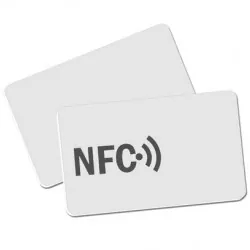
NFC & HF RFID Cards
Credit-card, key-fob & custom formats
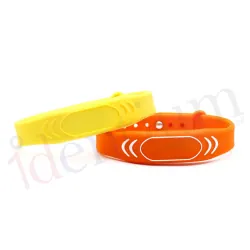
C07 Adjustable Wristband
Water parks, gyms & events
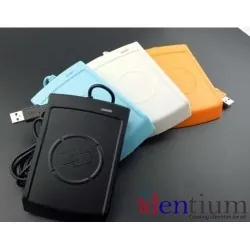
HF RFID Readers
Payment counters & access points
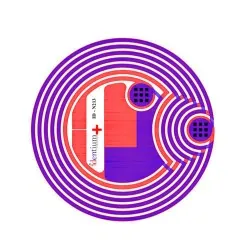
NFC Tags
Charms, pouches & fobs
The wider RFID wristband catalogue covers silicone, fabric and tamper-evident bands. On the software side, the closed-loop prepaid wallet platform ships with Android and iOS apps and runs either as a cloud-hosted monthly service or a one-time enterprise licence. Festival-scale deployments of the same model run on IDPay, Identium’s payment engine, scaled up for thousands of simultaneous wristbands.
Key benefits
- Cards, wristbands and readers are produced and encoded by us, so your institution deals with one supplier for the entire cashless stack.
- Payment and access control run on a single credential — fewer cards to issue, fewer to lose.
- Closed-loop spending stays inside your venue’s ecosystem: no card networks at the counter, no overcharging disputes, and no cash floats for staff to manage.
- Flexible commercials: start on the monthly cloud model, move to an enterprise licence when you scale.
- Deployed in Indian canteens, campuses, hospitals, gyms, hotels and amusement parks.
Download the IDentium Cashless Transaction Proposal for Educational Institutions
To request a demo, please contact us
Related: Hospitality · Education · Healthcare & Pharma
Choosing the credential and the counter hardware
Cashless payment at an event, canteen or water park is an HF 13.56 MHz job, not a UHF one. The relevant standards are ISO 14443 and ISO 15693 — the 13.56 MHz contactless family NFC is built on — and the short read range is the point rather than a limitation. A tap is a deliberate, one-credential-at-a-time act, so the till charges the guest at the counter and not the three people queuing behind them. Passive UHF typically reads across metres and would pick up the whole queue; EPC Gen2 and RAIN RFID (ISO/IEC 18000-63) are passive-UHF terms and do not apply to an HF payment credential at all. HF tap distance is typically a few centimetres, varying with the reader antenna, the card or band body, and what surrounds the counter.
Picking the chip
- Mifare Classic 1K — sectored memory with keys; widely used for canteen and campus wallets.
- Mifare Ultralight — the economical option, suited to single-event bands surrendered at exit.
- Mifare DESFire — AES-capable keyed security, where value or credentials held on the card need stronger protection.
- NTAG21x — phone-readable NDEF, more useful for letting guests check a balance on their own handset than for holding value.
Chip support varies by reader, so confirm the pairing before you order rather than assuming any chip works on any unit: our compact and desktop HF readers are listed for Mifare 1K, 2K, 4K and Ultralight, while the watch-type Bluetooth reader also covers DESFire, ISO 15693 (ICODE SLIX) and NTAG21x.
Where the balance lives matters more than the chip. Online-first, with the balance on the server and only an ID on the card, lets you block a lost band centrally and rebuild a guest’s wallet if the credential is damaged — but it needs connectivity at every till, often the weak point on an outdoor festival site. Holding value on the card keeps tills running through a network drop, at the cost of reconciling afterwards and of needing read-write hardware at every point where value changes. Settle this before ordering: it decides the chip, the memory and the readers you buy.
Matching readers to points of sale
| Point of use | Suitable reader | Why |
|---|---|---|
| Top-up and issue desk | IDTS-HRD20 desktop HF reader | USB plug-and-play beside a PC till |
| Fixed food or merchandise counter | IDTS-HMR65 compact HF reader | Battery-less over micro-USB, small footprint |
| Android POS or handheld till | IDTS-HRP60 portable HF reader | Connects to a phone or tablet over OTG |
| Roaming bar and vendor staff | IDTS-HBWR Bluetooth wrist reader | Watch-type and worn, so no fixed counter is needed |
| Venue with legacy 125 kHz cards | IDTS-DLH20 dual HF + LF reader | Reads old proximity cards alongside new NFC bands — it is a read-only unit, so pair it with a read-write reader wherever value is written |
Full specifications are on the HF RFID readers page. Every reader ships with an SDK, demo app and source code, so our wallet platform or your own POS software can be integrated directly.
One regulatory note, as of 2026: the WPC approval Identium holds covers its UHF readers and antennas on India’s licence-exempt UHF RFID band and is a separate matter from 13.56 MHz HF hardware; Identium is BIS certified. Confirm the current WPC and BIS position for your own specification rather than relying on a web page.
Cards and bands are printed, laser-marked or serial-numbered to your artwork, encoded to your key scheme, and tested in-house at our Delhi factory before dispatch.