

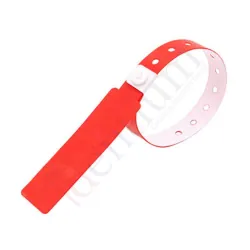
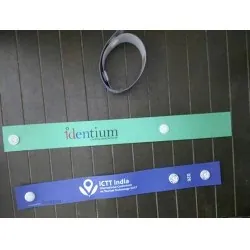
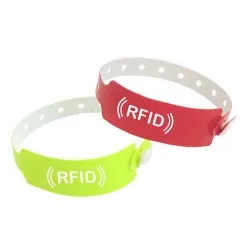
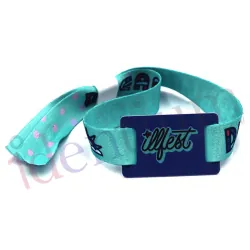

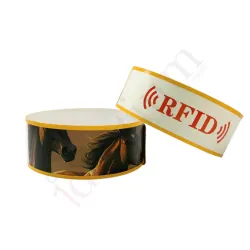
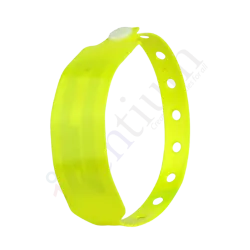


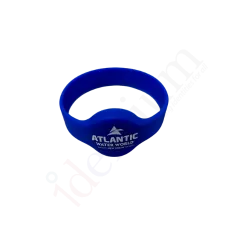
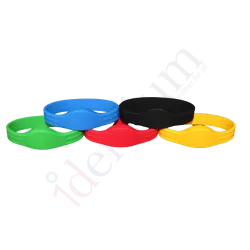
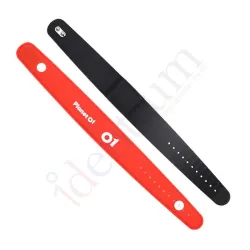
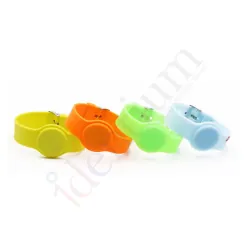
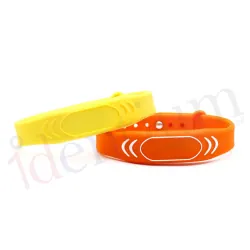
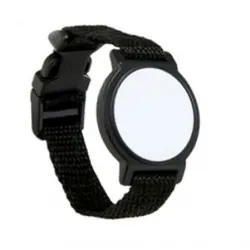
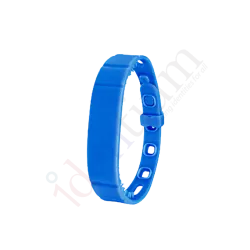

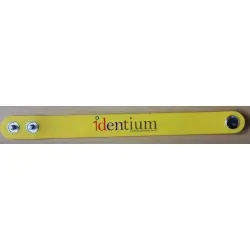
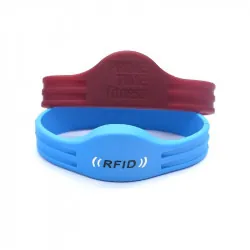
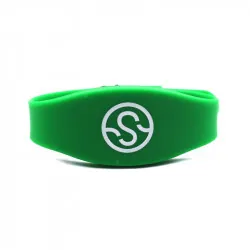
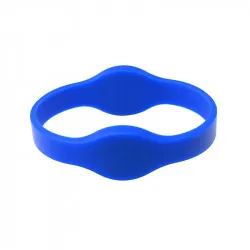
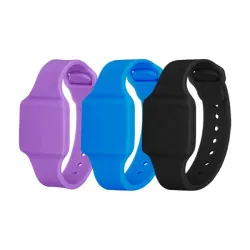
We manufacture and supply RFID Wristbands with LF, HF and UHF Chips
RFID Wristbands are widely used for:
Cashless Payments
Social Media Photo share
Access Control, Identification
Guest Management
RFID lockers
Patient Identification
Tourist Security & Identification
Why Buy RFID Wristbands from IDentium?
- Customised Printing and Color Options
- Short Lead Time : 2 days for 2500 PVC/Tyvek Wristbands, 15000 Wristbands Weekly capacity
- Lowest Price Guaranteed : Wristbands starting @ just INR 12.00/unit
- In House Design Team, Professional In CorelDRAW and Photoshop to get those Last Minute Designs ready
- One Stop Solution for Complete Design, Print, Packaging and Delivery.
- All RFID Chips Available including LF/HF/UHF Frequencies Identium Tamper-proof RFID PVC wristband is a multipurpose Wristband having excellent read performance which makes it useful in various applications including Revenue & Crowd control in Amusement & Leisure centres, Patient Identification, etc
Identium RFID Silicone wristband is a multipurpose Wristband having excellent read performance which makes it useful in various applications including Revenue & Crowd control in Amusement & Leisure centres, Access Control in Gyms & spas, RFID Lockers, etc
**Identium RFID Fabric wristband is a multipurpose Wristband having excellent read performance which makes it useful in various applications including Revenue & Crowd control in Amusement & Leisure centres, Access Control in Gyms & spas, RFID Lockers, **
Identium RFID Nylon wristband is a multipurpose Wristband having excellent read performance which makes it useful in various applications including Revenue & Crowd control in Amusement & Leisure centres, Access Control in Gyms & spas, RFID Lockers, Oil & Gas etc
Tyvek Tamper-proof Wristbands are available in all shapes and sizes. The wristbands are meant for one time use and come serialized with an option for custom printing Available in LF, HF/NFC & UHF
Identium RFID thermal wristband is a multipurpose Wristband having excellent read performance which makes it useful in various applications including Revenue & Crowd control in Amusement & Leisure centres, Patient Identification, etc
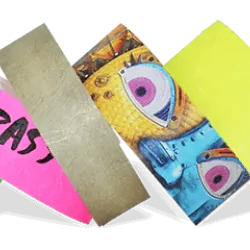
We manufacture RFID Paper Tickets.
Chip Options : Mifare S50, S70, NXP ICode SLI/SLIX
Call Us : +91 70110 01472
Write to us : [email protected]
Download our RFID Wristband Catlogue
Contact us for Custom RFID Wristbands, Access Control Systems and Solutions
Specifying the chip and the encoding before the run starts
Two decisions settle most wristband orders, and neither one is the strap. The first is which chip your readers and point-of-sale terminals can actually see. The second is how your software identifies the band — the one thing you cannot change once a run is printed and encoded.
Match the chip to the readers you will have on site
| Chip option | Standard and frequency | Where it fits | What constrains it |
|---|---|---|---|
| Mifare S50 / S70 | ISO/IEC 14443, HF 13.56 MHz | Gate taps, zone checks, cashless spend | A typical centimetre-range tap, presentation-dependent; the S70 is the larger-memory part of the two; Classic sector keys identify a band rather than secure value. Whether an ordinary handset can read one depends on the chip and the phone, so test your actual devices before you design a phone-based spot-check |
| NXP ICODE SLI / SLIX | ISO/IEC 15693, HF 13.56 MHz | The same tap applications, with a more forgiving presentation | Your readers and POS terminals must support 15693 — a 14443-only terminal will not see these bands at all — and handset support for 15693 also varies by phone |
| UHF option | EPC Gen2 / ISO/IEC 18000-63, marketed as RAIN RFID, 865-868 MHz in India | Free-flow entry lanes, and timing points where a band rather than a bib carries the tag | The wrist sits against the body, which absorbs UHF, which is why wrist-worn UHF formats use a spacer or ceramic construction and still have to be proven on site with your own antenna positions. Readers must be supplied for 865-868 MHz, not the 902-928 MHz used in the United States |
| LF 125 kHz | Legacy proximity | Only where the venue already runs 125 kHz readers you have to match | It buys compatibility with an existing estate, not capability — HF does everything these bands do |
For most festivals and conferences the answer is HF 13.56 MHz, because a tap is deliberate and lands on one guest rather than the three standing behind them.
Before you commit to a UHF gate, look at the shape of the band rather than just its edges. India’s licence-exempt UHF allocation is 865-868 MHz under G.S.R. 853(E) of 10 December 2021, made in supersession of the 2005 rules that set 865-867 MHz. Inside it, the full 2 W e.r.p. reader power is permitted only on the four 200 kHz channels centred at 865.7, 866.3, 866.9 and 867.5 MHz, and a reader may not sit on one of those channels indefinitely before pausing. A compliant portal therefore hops across four narrow channels rather than flooding a continuous band, and in a tightly packed lane that channel budget is part of your read-rate maths. That is the position as of October 2026 and notifications get amended, so confirm the current rule with the WPC, and see our BIS and WPC compliance guide, before you fix a lane layout.
Decide how the band is identified before production
Ask your ticketing or cashless platform whether it keys on the chip’s factory unique ID or on data written into user memory. The two run opposite ways. UID keying means every band has to be read at issue to bind it to a guest, so bands cannot be assigned before they are in someone’s hand — but reusing them next season is only a database remap, with nothing to re-encode. Data keying lets bands arrive already encoded against a ticket range, so there is no enrolment scan at the desk, at the cost of wiping and re-encoding anything you want to use again.
If you want a file mapping each band’s chip identifier — the UID on an HF band, the EPC on a UHF one — to its printed serial, ask for it when you order and name the format your platform imports; we will confirm what we can supply. Importing that list is faster than reading bands one at a time at a registration table.
The mistake buyers make
Treating the chip as the only credential. Put a printed serial on every band, and a QR as well if your staff app scans one, mapped to the chip, so a failed band or a dead reader can still be cleared by hand at the gate. Order replacement stock inside the same production run: bands are built to your written specification, so spares have to be made with the batch rather than added to it later.
Related reading
- UHF, HF and NFC compared before you fix a frequency
- Buyer’s guide to RFID wristbands for events and festivals
- Closed-loop NFC cashless payment systems for venues