

We provide RFID solutions for the luxury industry, including RFID software for luxury goods inventory tracking that decreases losses and protects brand value. At Identium we understand how quickly scenarios change in this market, and we deliver tailor-made solutions that enhance brand image across every domain the luxury world caters to — beginning with authentication.
The world of fashion continuously adapts to consumer tastes and interests. Keeping pace with the growing desire for heightened extravagance, fashion houses are responding with an extraordinary volume of luxe, exclusive designs — across couture, runway collections and premium lifestyle. Every one of those pieces deserves an identity that proves it is genuine, and RFID is the most practical way to give it one.
Where RFID fits in the luxury industry
- On-the-spot authentication — scan the label embedded in the surface of a handbag or other luxury article and check it against a reference database to confirm the item’s details and authenticity instantly.
- Counterfeit blocking — track-and-trace hangtags with tamper-proof embedded tags stop counterfeits seeping into the supply chain, with complete process authentication from production studio to luxury store.
- Customer-facing verification — a cloud-based portal verifies product authenticity and presents the item’s details for the customer’s view, turning provenance into a selling point.
- Boutique inventory accuracy — count an entire floor of merchandise in minutes with a handheld reader, so every style and size is exactly where the system says it is.
- Discreet loss prevention — exit readers identify exactly which tagged piece left the store, without intrusive gates that clash with a premium interior.
- High-value showcase audits — watches, jewellery and accessories are reconciled tray by tray at opening and closing.
Recommended Identium hardware
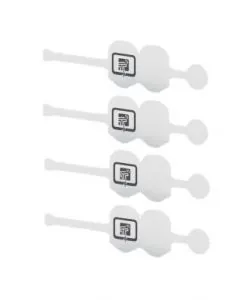
- UHF RFID inlays and labels — slim inlays for hangtags and embedded labels, including jewellery label formats.
- NFC and HF RFID tags — tap-to-verify authentication experiences on the customer’s own phone.
- CX1500N handheld RFID reader — boutique stocktakes and instant single-item lookups.
- HLR200 UHF gate reader — discreet exit monitoring for loss prevention.
- UHF desktop readers — encode and commission each piece at the studio or distribution centre.
Related solutions
- RFID jewellery management solutions
- RFID retail loss prevention
- RFID for apparel and fashion retail
- RFID for the perfume industry
Protect what makes your brand worth its price. Talk to our team about an authentication and inventory programme tailored to your label.
Specifying RFID for luxury goods: frequency, materials and tag format
A luxury programme almost always runs two frequencies doing two different jobs. Mixing them up is the specification error that is most expensive to unwind, because by the time it shows up the tags are already sewn, riveted or boxed into finished stock.
The floor-level work described above — stock counts, showcase audits, exit monitoring — sits on passive UHF. In India that means the 865–868 MHz band, which the WPC has delicensed for RFID; as of 2026 that is the band to design to, and you should confirm the current WPC and BIS position for your own deployment before you commit to hardware (see our BIS and WPC compliance guide). Passive UHF — EPC Gen2, the ISO/IEC 18000-63 air interface marketed as RAIN RFID — is the practical way to read many items at once from a distance on a tag cheap enough to attach to every single piece. Expect typically up to around 10–15 m at a fixed reader, less on a handheld, and less again on small jewellery tags and on-metal tags. Treat any range figure as environment-dependent rather than guaranteed.
Customer-facing tap-to-verify is a separate specification. A standard smartphone reads NFC, not UHF, so anything the buyer authenticates for themselves has to be HF at 13.56 MHz — an NFC chip on the ISO/IEC 14443 standard, read over typically a few centimetres, one item at a time. Where a brand wants both the floor audit and the phone tap on the same piece, a dual-frequency tag carries a UHF chip and an NFC chip in one body. Worth stating plainly, because datasheets blur it: EPC Gen2 and RAIN RFID describe passive UHF only. An HF or NFC inlay is neither, however loosely the terms get used.
Materials then decide the tag format. Gold, silver, watch cases, metal clasps and foil-stamped packaging all detune a flat inlay, and perfume and other liquids absorb UHF energy. Mirrored, glass-and-metal display cabinets reflect signal, so a boutique reader usually needs its power turned down and its antenna aimed deliberately, or it will read the next showcase along.
| What you are tagging | Tag format | Frequency |
|---|---|---|
| Handbags, leather goods, ready-to-wear | Printed hangtag with UHF inlay | UHF 865–868 MHz |
| Rings, chains and small pieces | Jewellery tag (dumbbell / rat-tail format) | UHF 865–868 MHz |
| Watches, metal plinths, display fixtures | On-metal (anti-metal) hard tag | UHF 865–868 MHz |
| Boxes, certificates, authenticity cards | Adhesive inlay, or PVC/PETG card | UHF if it must be counted in bulk, HF if the buyer taps it |
| Customer tap-to-verify on a phone | NFC inlay or label | HF 13.56 MHz |
Identium manufactures these tags at our New Delhi factory with custom printing, laser marking, artwork and serial numbering, so each piece can leave the studio already encoded with its own identity. Custom tags typically run a 5–10 day turnaround, and units are tested in-house before dispatch.
Related reading
- Dual-frequency NFC + UHF RFID tags explained — one tag that a phone and a warehouse reader can both read.
- RFID in jewellery retail: stock audits and billing — how a showroom actually runs tray counts day to day.
- Digital Product Passport and RFID for Indian exporters — what EU product-passport rules mean for branded goods.