
An RFID key fob is an RFID credential in a small sealed body that hangs on a keyring, so staff, members and residents present their keys to a reader instead of carrying a card. Identium lists two RFID keychain tags: the 53 × 37 mm LF TAG at 125 kHz, and the 46 × 30 mm RKT in LF EM4100, HF MIFARE Classic 1K or UHF EPC Gen2 versions. The rule throughout: match the fob to the reader already installed.
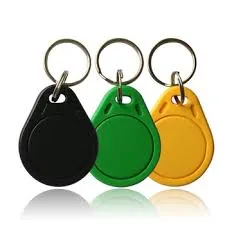
The two fobs, side by side
Values are from the store listings.
| LF TAG | RKT | |
|---|---|---|
| Form factor and size | Keyring fob, 53 × 37 × 5.3 mm (±0.2 mm) | Oval keyring fob, 46 × 30 × 6 mm |
| Frequency | 125 kHz (LF) | 125 kHz (LF), 13.56 MHz (HF) or UHF, tuned for India’s licence-exempt 865–868 MHz band (G.S.R. 853(E), 2021) |
| Chip | Not stated; confirmed at quotation | EM4100 (LF); MIFARE Classic 1K (HF); UHF version uses the EPC Gen2 protocol, chip not named |
| Weight | 3.0 g (±0.2 g) | Not stated |
| Material | Not stated | ABS |
| Ingress rating | IP67 | IP67 |
| Operating temperature | Not stated | −25 °C to +70 °C |
| Mounting | Keyring | Keyring hole, 4 mm diameter |
| Read range | Not stated; reader dependent | LF 2–10 cm; HF up to 10 cm; UHF 1–5 m; all reader dependent |
| Printing and colours | Not stated | Logo engraving, colour printing, sequential serial numbers; black, white, blue, red, yellow or green |
| What it is for | Door access, attendance and gym entry with an LF reader | Door access, attendance, gyms and parking, in the version that matches the installed reader |
Start from the reader, not the fob
A fob and a reader must share a frequency before anything else matters: a 125 kHz reader cannot see a 13.56 MHz fob, and the reverse is also true. Within one frequency the reader must also understand the chip, which the matrix below sets out. The UHF RKT is the third case: the EPC Gen2 version, read by fixed UHF readers at gates and car parks.
Unsure what is installed? Our guide on how to tell a 125 kHz card from a 13.56 MHz card applies equally to fobs, and the HF RFID readers page explains what “supports MIFARE” means on a reader datasheet.
Chip-to-reader compatibility matrix
| Chip | Frequency and standard | What the chip holds | Reader it needs | Phone NFC | In Identium’s fob listings |
|---|---|---|---|---|---|
| EM4100 | 125 kHz (LF) | Read-only 64-bit code programmed at the factory | 125 kHz reader that supports the EM4100 format; confirm against the reader model | No | Yes: RKT LF |
| T5577-type | 125 kHz (LF) | Rewritable; coding and data rate configurable | 125 kHz reader that accepts the chip’s configuration; test first | No | Not listed; ask |
| MIFARE Classic 1K | 13.56 MHz (HF), ISO/IEC 14443 A | 1 kB in 16 sectors of 4 blocks; the UID sits in block 0 and each sector’s last block holds its two keys | ISO/IEC 14443 A reader for the UID; sector data needs a reader that supports MIFARE Classic authentication and holds the sector keys | Android detects it, but MIFARE Classic support is optional | Yes: RKT HF |
| MIFARE Ultralight | 13.56 MHz (HF), ISO/IEC 14443 A | Small memory in 4-byte pages | ISO/IEC 14443 A reader | Generally readable by NFC phones; can be formatted as an NFC Forum Type 2 tag | Not listed |
| NTAG | 13.56 MHz (HF); most NTAG parts use ISO/IEC 14443 A, some use ISO/IEC 15693 | NFC Forum (NDEF) memory; tag type varies by NTAG family | HF reader matching the chip’s standard, or an NFC phone | Designed for NFC devices | Not listed; ask |
| UHF EPC Gen2 | UHF, ISO/IEC 18000-63 | EPC Gen2 tag; chip not named in the listing | UHF EPC Gen2 reader covering the fob’s 865 MHz band tuning (fixed reader at gates) | No | Yes: RKT UHF |
Whether a system uses only the fob’s UID or reads sector data is decided by the reader and its software, not by the fob.
Read range and daily carry
The RKT listing gives LF 2–10 cm, HF up to 10 cm and UHF 1–5 m; all figures depend on the reader, its antenna and mounting. The LF TAG listing gives no read range, so test it on your reader before rollout. At a door the short LF or HF tap is a feature, because the reader responds to the fob deliberately held against it; the guide to RFID cards for access control explains how range trades against deliberate presentation.
LF has no anti-collision in practice, so an LF reader handles one tag at a time. Two LF fobs on one keyring, presented together, may not read; present one at a time.
Both fobs are rated IP67 in their listings, which suits daily carry. The RKT’s operating temperature is −25 °C to +70 °C; its listing gives no storage figure.
Security and lost fobs
An EM4100 fob returns a fixed factory code, and nothing on the chip authenticates it, so it suits gym or society entry better than sensitive doors. The HF RKT’s MIFARE Classic 1K sector keys add protection only when the system reads sector data, not just the UID.
Each EM4100 fob carries its own factory code, so a lost fob is replaced by enrolling a new one and deleting the old code in the access software; the same routine applies to the HF and UHF versions. Keep a record of which fob went to whom when you issue them, so the right code can be found and deleted quickly.
Printing, colours and numbering
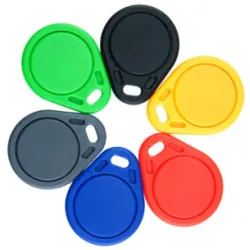
On the RKT, body colour and print are separate choices: one of six body colours (black, white, blue, red, yellow or green) can mark an access tier or a building block, and the logo or sequential serial number is engraved or printed on top.
A printed number is only useful if it matches what the reader or attendance software shows, so confirm that format on the live system before the batch is printed. For the reader side of a door installation, see the store’s guide to setting up RFID door access.
Where fobs fit: societies, gyms, offices and parking
Typical uses:
- Housing societies. Residents present a fob at the entry panel; check whether the panel reads 125 kHz or 13.56 MHz first, and which chip it expects, since the frequency alone does not settle it.
- Gyms. Member entry at the front desk or turnstile; a printed serial number lets staff match a returned or lost fob to the member record.
- Offices. Staff door access and attendance; see RFID access control and biometrics and the RFID time and attendance system.
- Locker banks. LF and HF fobs (not the UHF RKT) can be paired with RFID locker locks; confirm the chip family each lock model accepts first.
- Parking. The UHF RKT is read by a fixed UHF reader at the gate; see RFID vehicle parking management.
Coin-shaped tokens are another form factor for the same kind of credential; ask if your design needs one. For PVC and PETG credentials see RFID cards, and for HF inlays, labels and ABS tags see NFC and HF RFID tags.
Choosing and ordering
To match a fob first time, send the reader make and model or a sample fob, the chip if known, the quantity, and your printing and numbering needs, including the number format your software shows. If the site runs more than one reader type, say which doors use which, so each group gets the version its reader accepts.
Both fobs are on the store: the LF TAG 125 kHz keyfob and the RKT keyfob in LF, HF or UHF. Pricing is quoted against specification; contact us with the details.