

Identium provides complete RFID solutions for pet management to kennel clubs, breeding houses and animal labs in research institutions. RFID pet identification starts at the clinic: small pets are registered with agencies once they are uniquely identified with injectable, bio-safe glass tags inserted into their bodies at pet clinics. From that moment, every animal carries a permanent identity that no collar or paper record can match.
Veterinarians can monitor the health of each animal throughout its lifetime, giving individual attention at every clinic visit. The same identity makes it possible to trace lost pets and notify owners at their registered address. We also build portals that let municipal authorities manage pet populations and generate revenue through authorised licensing.
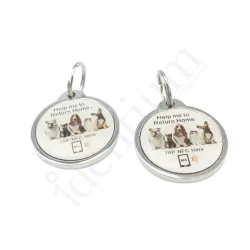
Where RFID fits in pet management
- Microchip registration — injectable bio-safe glass tags give each pet a unique, tamper-free identity, registered with the appropriate agency at the time of implantation.
- Lifetime health records — a quick scan at the clinic pulls up the animal’s complete history, so vaccinations, treatments and check-ups follow the animal rather than the paperwork.
- Lost pet recovery — any clinic or shelter that scans a found animal can identify it and have the owner notified at the registered address.
- Municipal licensing — civic-body portals tie pet registrations to licence issuance and renewals, converting an unmanaged register into a revenue stream.
- Kennel clubs and breeding houses — litters, pedigree records and breeding histories stay linked to individually identified animals.
- Research institutions — animal labs identify each subject unambiguously, protecting the integrity of long-running studies.
Recommended Identium hardware
- RFID animal tags — injectable glass tags plus ear-tag and collar options for different species and settings.
- UHF desktop readers — front-desk registration, record lookup and tag encoding at clinics and licensing counters.
- CX1500N handheld RFID reader — mobile reading for kennels, shelters and field licensing teams working with UHF-tagged animals and assets.
Related solutions
- Animal identification RFID tags
- RFID livestock tracking for farms and larger herds.
Whether you run a clinic chain, a kennel club or a municipal licensing programme, we can put a complete pet identification system together for you — talk to our team.
Which frequency actually reads a pet
The implanted microchip is a low-frequency device, not a UHF one. ISO-standard companion-animal transponders work at ~134.2 kHz under ISO 11784/11785, and that single fact shapes everything downstream. Low frequency couples inductively through tissue and body fluid without the detuning that troubles higher bands, so a scanner passed over the shoulder blades typically reads only at close range — centimetres, not metres, and that is by design rather than a limitation. Scanners in clinics and shelters are generally built for that band, which is what makes a found animal identifiable in the first place. Passive-UHF vocabulary — EPC Gen2, RAIN RFID, ISO/IEC 18000-63 — does not apply to an implant at all; it belongs to the 865–868 MHz tags on kennel doors, crates and grooming trolleys.
Most pet programmes therefore run more than one band, each doing the job it is suited to:
| Layer | Frequency | Typical tag | How it is read | Typical read distance |
|---|---|---|---|---|
| Permanent animal identity | LF ~134.2 kHz | Bio-safe glass transponder | Handheld scanner passed over the animal | A few centimetres; contact range in practice |
| Owner card, collar token, clinic file | HF 13.56 MHz | NFC tag, PVC or PETG card | Phone or desktop reader | Touch to a few centimetres |
| Kennels, crates, cages, equipment | UHF 865–868 MHz | Printed label, on-metal or cable-tie tag | Handheld or fixed reader | Up to a few metres, depending on the environment |
Three things buyers tend to discover late. First, the identification code on an ISO 11784/11785 transponder is normally written at manufacture and read-only afterwards, presented as 15 digits — so your database maps to that number rather than rewriting it, which means the registry has to be designed before the software is. Second, an implant only helps for as long as the registry entry behind it carries a current owner address; the recovery workflow, not the chip, is where these schemes usually break down. Third, kennel and clinic hardware is often stainless steel or galvanised mesh, so the UHF asset layer needs on-metal tags rather than plain labels, and even those read shorter near metal than open-air figures suggest.
The tags we manufacture for that asset layer — labels, cards, on-metal and cable-tie tags — can be laser-marked, serial-numbered and encoded to your own scheme, with customised orders typically turned around in five to ten days and units tested in-house before dispatch. The UHF readers and antennas we supply are, as of 2026, WPC-approved for India’s licence-exempt UHF RFID band, and the readers ship with an SDK, demo app and source code — which matters when clinic or kennel software has to talk to the reader directly.