
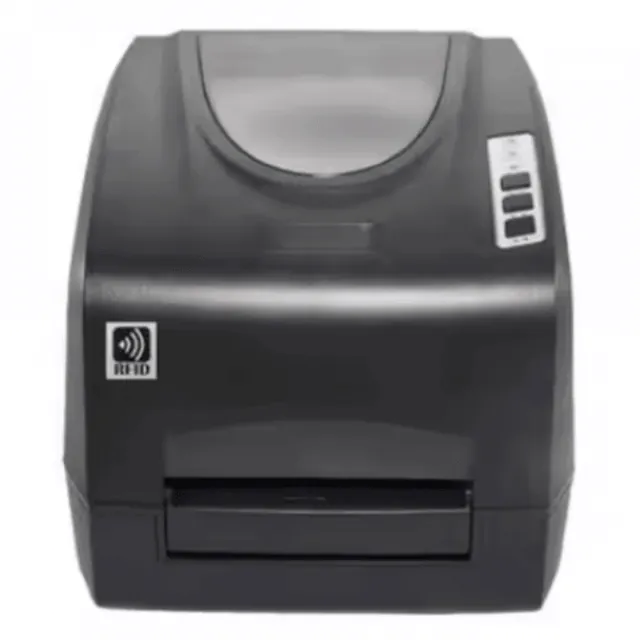
The iT4R (current production model IT4RL) is Identium’s desktop RFID printer and encoder for printing and programming UHF labels in one pass. Unlike ordinary barcode printers, it handles the full spread of UHF media — standard paper and PET labels as well as anti-metal labels up to 1 mm thick — so the same desktop machine can produce shelf labels, asset labels and on-metal tags. With its high-speed print head it can turn out and encode up to 6,000 RFID labels per hour, enough for most tagging projects without stepping up to an industrial unit.
Key specifications
- Prints and encodes all common UHF label types, including soft labels and on-metal labels up to 1 mm thickness
- Print speed up to 8 ips; rated for up to 6,000 printed and encoded RFID labels per hour
- Supports UHF anti-metal label media for asset and equipment tagging
- Interfaces: USB standard, TCP/IP network connectivity optional
- Bundled free Labelsoft label design and printing software: imports and exports Excel, MySQL, SQL and text files, prints EPC and TID values, pushes data to an API and prints directly from a database
Applications
- On-demand asset label printing for IT, plant and facility tagging drives
- Retail and apparel label encoding ahead of store rollouts
- Warehouse location and carton labelling
- Jewellery, file and document tag personalisation
- Service bureaus producing pre-encoded labels for client projects
Specifying an iT4R: what actually decides the outcome
Band first — and what this printer will not encode
The iT4R is a passive UHF machine: the labels it writes carry EPC Gen2 chips (ISO/IEC 18000-63, the air-interface standard also marketed as RAIN RFID). For an Indian installation the encoder’s region setting and the inlays should both be specified for the licence-exempt UHF RFID band, which has been 865–868 MHz since G.S.R. 853(E) of 10 December 2021 was made in supersession of the 2005 Rules that set 865–867 MHz. That matters on a printer quote, because older datasheets and encoder region menus still read 865–867 — a tuning inside the current allocation, not a separate band. Confirm the current position with WPC before a specification is frozen; our BIS and WPC compliance guide covers what to ask a supplier for. Tell us the country of installation on the enquiry: India and ETSI Europe share 865–868 MHz, so the mismatch that actually causes trouble is hardware set for a US site at roughly 902–928 MHz.
The RFID module fitted inside decides what the machine can write, so confirm the fitted module on the quote rather than assuming it:
| What you need to tag | Band and standard | iT4R? |
|---|---|---|
| Carton, shelf, apparel, file and asset smart labels | Passive UHF, EPC Gen2 / ISO/IEC 18000-63 | Yes |
| Anti-metal label stock up to 1 mm, for plant and IT assets | Passive UHF | Yes |
| Access or ID cards and NFC tags | HF 13.56 MHz (ISO 14443 / 15693) | No |
| Livestock ear tags | LF 125 / 134.2 kHz (ISO 11784/11785) | No |
HF and NFC media need an HF encoder — see RFID cards and NFC and HF tags. Livestock ear tags are not label stock at all: animal ear tags are moulded, laser-engraved and encoded in production, not fed through a desktop printer. And if you never need printed artwork and only want EPCs written to loose UHF tags or cards, a desktop encoder is usually the simpler and lower-cost route — ask for both on one quote and compare.
Inlay pitch, not print speed, sets your real throughput
Up to 8 ips, and a rating of up to 6,000 printed-and-encoded labels an hour — under two a second — describe the engine, and that is more than most tagging drives ask of it. What costs throughput in practice is encoding, not printing. The chip has to sit where the encoder expects it, so a roll at the wrong inlay pitch or offset fails verification and those labels are wasted: you lose time and media together. Buy rolls matched to the machine and run a test roll before committing to a large media order. Keep artwork clear of the chip and antenna footprint too — printing over the inlay bump can damage it and spoil the write.
Thickness, ribbon and duty cycle are three separate questions
Two things decide desktop versus industrial, and they are not the same thing. Media thickness is one: rigid anti-metal stock is what usually rules a desktop unit out, and the iT4R takes it to 1 mm. Duty cycle is the other — a desktop machine suits bursts through the working day, while a continuous full-shift line is what the iX4R is for. Settle them separately rather than letting one decide the other.
Then match the ribbon to the label’s working life rather than to the printer: wax for everyday paper labels, resin where heat, chemicals or abrasion are involved. Over a few years the media and ribbon bill can add up to more than the machine cost, so put consumables into the comparison at the quote stage, not after the first roll runs out.
Send us this and the quote will be right first time
- Label size, facestock, adhesive and required print life
- Inlay type, antenna position and pitch on the roll
- Surface being tagged — metal, plastic, card, carton
- Daily and peak label volume, bursts or continuous
- EPC/serial scheme and where the data lives (Excel, MySQL, SQL or an API)
- USB as standard, or the optional TCP/IP network interface
- Country of installation, so the encoder region and inlays are specified together
The mistake we see most often is ordering the printer first and sourcing media later. Quote the machine and the labels together.
Related reading
- Working out which chip to specify? Read our guide to UHF RFID chips, EPC and TID memory.
- Only need to write EPCs without printing? See UHF RFID desktop readers and encoders.
- Tagging to a customer’s mandate? Read meeting a retailer RFID mandate as a supplier.
For round-the-clock, heavy-duty production lines, the iX4R industrial RFID printer is the step-up option in our range — see the iX4R at India RFID Store or browse all RFID printers. The iT4R is stocked in New Delhi along with compatible UHF inlays and labels. Request a quote for printer-plus-media bundles, or buy online at India RFID Store.
Who buys the iT4R in India
Buyers comparing desktop RFID printer prices in India are typically tagging teams that want labels printed and encoded in-house rather than ordered pre-printed: IT and facility managers running asset tracking drives, retail and apparel chains encoding labels ahead of store rollouts, and warehouses producing location and carton labels on demand. Because the iT4R handles on-metal label media up to 1 mm thick alongside standard paper and PET stock, one desktop unit typically covers both shelf labelling and equipment tagging — a spread that usually pushes buyers towards costlier industrial machines. Service bureaus also use it to turn out pre-encoded labels for client projects at up to 6,000 labels per hour. Pair it with compatible UHF inlays and labels stocked in New Delhi, read our RFID printer buyer’s guide, or request a quote for printer-plus-media bundles.