
Identium makes RFID patient wristbands in New Delhi for adult inpatients, children and newborns. The bands are passive, with no transmitter, and are chosen by reader frequency, closure and print data. This page covers the band; system design sits on our RFID patient tracking system and RFID infant monitoring solution pages.
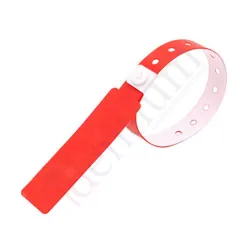
Adult, child and newborn bands: which SKU fits which patient
- Adult inpatients: the IDTS-TRPW (UHF version) is a disposable PVC band for bedside identification, also readable by fixed UHF readers at ward, lab and theatre doors. The IDTS-TRPW (HF version) shares its PVC build, closure and print options, with a 13.56 MHz HF/NFC chip; its wearer size is not stated.
- Newborns and infants: the UHF infant band is a small, disposable PVC band with an Alien Higgs 3 UHF chip, for identifying the baby on the ward, mother–baby matching and reads at nursery exits. Its store page carries the adult band’s model code and specification, so ask for the infant size to be confirmed in writing.
- Children: the UTW01 comes in adult and child sizes.
- An adjustable band: the C07 adjustable RFID wristband; see its page for material, sizing and chip options.
Band dimensions and age ranges are not published for any of these bands.
HF/NFC or UHF: let the reader at the point of care decide
The IDTS-TRPW (HF version) runs at 13.56 MHz. Staff confirm who the patient is by tapping the band with an HF reader or NFC-enabled device at the bedside; with a handheld or desktop HF reader the band is read only when it is presented. The IDTS-TRPW (UHF version) is tuned 860–960 MHz, which covers India’s licence-exempt 865–868 MHz band under G.S.R. 853(E) of 10 December 2021 (our RFID frequencies page sets out the allocation), and fixed readers at doors read it without a tap.
Three constraints follow:
- A phone’s NFC reads HF/NFC bands and can never read UHF, but not every phone reads every HF chip (Android treats MIFARE Classic support as optional). Test the chosen chip on the handsets and app you plan to use before ordering in volume.
- A UHF reader cannot read an HF band, and an HF reader cannot read a UHF band.
- Body tissue holds water, which absorbs UHF energy, so a UHF band on a wrist reads shorter than the same tag in free air. Validate range on a worn band.
Our HF RFID readers cover the bedside tap, and the HF and NFC tags range covers other 13.56 MHz form factors. Each band here carries one chip; if a band must answer both a tap and a doorway, read about dual-frequency NFC + UHF tags first.
Chip options and memory
The IDTS-TRPW (UHF version) and the UHF infant band come with an Alien Higgs 3 chip (other chips on request), EPC Class 1 Gen2 / ISO 18000-6C (now ISO/IEC 18000-63, a passive UHF standard) and 512-bit user memory. The UTW01 names no chip or memory size, and the P01’s chip, HF or UHF, is customised on request, so name your chip family when ordering either.
The IDTS-TRPW (HF version) is offered with these chip options:
- NXP NTAG203 / NTAG213 (ISO 14443A, 144 bytes)
- MIFARE Ultralight (ISO 14443A, 512 bit)
- MIFARE Classic 1K S50 (ISO 14443A, 1 KB)
- NXP ICODE (ISO 15693; listed as 512 bit; ICODE memory varies by IC, so ask which ICODE IC is fitted and its user memory)
- other chips on request
Match the chip to the readers you already run: a reader must support the chip’s standard (ISO 14443A for NTAG and MIFARE, ISO 15693 for ICODE), not just 13.56 MHz. Each model on our HF readers page lists the card types it reads, so send the chip part number and ask for the reader match in writing.
Closures: button, adhesive, snap-fit or adjustable
- IDTS-TRPW (UHF and HF): PVC with a button or adhesive closure, tamper-proof and single use.
- P01: a tamper-proof, single-use closure, so a band cannot be moved to another wearer unnoticed.
- UTW01: a tamper-evident snap-fit clasp that breaks if removed.
- C07: an adjustable band (see its page for the closure).
Whether a cut or removed band raises an alert is a system decision, not a band property; see the infant monitoring solution.
Pre-printed and pre-encoded, or printed at admission
IDTS-TRPW bands take a logo, text, variable barcodes, QR codes and data sets, and P01 bands take barcodes, QR codes and variable data sets; both are pre-encoded on request. The UTW01 can be printed with a full-colour logo, an event name, a barcode or a QR code, so ask for patient-name printing to be confirmed in writing. IDTS-TRPW bands come in blue, red, green, yellow, orange and white (others on request), useful for colour-coding by ward or patient type, packed 250 per roll.
Fixed data can be printed and encoded at the factory. None of these bands is described as supplied for desk printing, so confirm it per SKU in writing. If a band is confirmed for it, issuing per-patient data at the desk needs an RFID printer (Identium supplies Zebra, TSC and Honeywell models), or for encoding a UHF desktop reader for UHF bands or a read-write HF reader for HF bands.
RFID patient wristband specifications side by side
| Model | Wearer | Frequency | Chip and memory | Closure |
|---|---|---|---|---|
| IDTS-TRPW (UHF) | Adult | UHF, EPC Gen2* | Alien Higgs 3, 512-bit user | Button or adhesive |
| UHF infant band | Newborn, infant | UHF, EPC Gen2* | Alien Higgs 3, 512-bit user | Button or adhesive |
| IDTS-TRPW (HF) | Not stated | 13.56 MHz HF/NFC | NTAG, MIFARE or ICODE | Button or adhesive |
| P01 | Not stated | HF or UHF | On request | Tamper-proof |
| UTW01 | Adult, child | UHF, EPC Gen2* | Not named | Snap-fit clasp |
*Tuned 860–960 MHz, which covers India’s licence-exempt 865–868 MHz UHF RFID band under G.S.R. 853(E).
All five are single-use PVC bands. The three IDTS-TRPW bands are rated -25 to +60 °C for both operating and storage; the P01 and UTW01 give no temperature. Only the UTW01 gives a read range (0.5–3 m with a handheld reader, up to 8 m with a portal reader); it is reader dependent, so validate it on a worn band. For the other bands, read range is not stated and depends on the reader.
What applies to a band: NABH, WPC, BIS
NABH’s hospital accreditation standard (6th edition, in force from 1 January 2025) makes it a core element at COP.1.b that a hospital has a uniform process for identifying patients using at least two identifiers. Its standard for small healthcare organisations (3rd edition, August 2022) asks the same at COP 1.a. Neither standard’s objective elements mention RFID or wristbands, so an RFID band is one way to carry those identifiers, not an accreditation requirement.
A passive band has no transmitter, so it needs no WPC approval and no BIS registration. WPC approval belongs to readers and antennas and BIS registration to readers. Identium is a BIS and WPC approved RFID manufacturer, and our BIS and WPC buyer’s guide explains where each approval applies. For the band material, ask for the SKU’s material-compliance declaration in writing.
Choosing and ordering
Send these details through our contact page:
- patient groups (adult, child, newborn) and quantities for each
- the readers in use, or the chip family you need
- closure type and colours
- print and encoding data, and whether bands will be printed in-house
Pricing is quoted against specification (the store’s RFID wristband price guide covers cost), and custom tag orders typically turn around in 5–10 days. For a newborn security system, see the store’s RFID infant monitoring system and our Govt. of Tamil Nadu infant monitoring case study. Event and access bands are in the wider RFID wristband range.