
In India, an RFID library tag, also sold as an RFID book tag, comes in two families: HF labels read at 13.56 MHz under ISO 15693 (the listings here use the ICODE SLIX2 chip), and passive UHF EPC Gen2 strips and stickers. This page covers the tag itself; kiosks, gates and LMS integration are on our RFID library management system page.
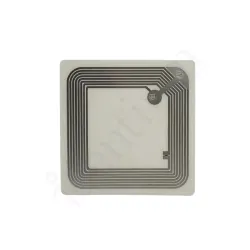
HF book labels: ICODE SLIX2 in 50 × 50 and 80 × 50 mm
Both labels are passive, listed for multiple reading, and carry an EAS anti-theft alarm bit. Thickness is 0.3–0.5 mm, and the face can be printed with the UID, serial number, barcode, QR code or logo.
- Slix2-50x50: wet inlay 50 × 50 mm, dry inlay 45 × 45 mm, for slim books and journals where an 80 mm label will not fit; roll on a 3-inch core, 66 mm liner.
- Slix2-80x50: wet inlay 80 × 50 mm, dry inlay 76 × 45 mm.
Custom sizes are available on request. Both listings give New Delhi, India as the place of origin. Other 13.56 MHz formats are on our HF RFID inlays page.
UHF book tags: spine strips and stickers
Six passive UHF EPC Gen2 tags are listed for books and archive items. Where a record gives 860–960 MHz, that is the chip’s global tuning span, which covers India’s licence-exempt 865–868 MHz band under G.S.R. 853(E) of 10 December 2021. Every row below covers India’s band, and the ID-9503-U9 also lists 902–928 MHz.
| Model | Form and size | Chip (as listed) | Listed range | Listed for |
|---|---|---|---|---|
| 125x7-H10 | Label, 125 × 7 mm | Alien Higgs 10 | Not listed | Book spines |
| ID-9503-U9 | Tag, 95 × 3 mm | U9 (NXP UCODE 9) | Up to 5 m | Spines, self-checkout, audits |
| ID-0395-QUANRAY | Printable label; size not listed | Quanray | Up to 6 m | Printed book labels |
| ID-RFID0S0395H10LABELFORLIBRARYWINE | Strip label; size not listed | H10 | Up to 7 m | Books, wine bottles |
| ID-1540EC | Sticker, 15 × 40 mm | Alien Higgs EC | Up to 5 m | Books, wine, archive files |
| ID-RFID0S0395TAG | Strip inlay; size not listed | Not named | Up to 6 m | Files, tubes, rods, boxes |
All ranges are record maximums, dependent on reader, antenna and environment; none is a shelf-audit, gate or stack figure. The 125x7-H10 has a 95 × 3 mm etched-aluminium antenna on 50 µm PET.
The 125x7-H10 record lists EPC 128 bits, TID 96 bits and user 32 bits; Alien’s Higgs 10 datasheet describes the 32 user bits as available with a 96-bit EPC or used to extend the EPC to 128 bits, so state which split you need. The ID-9503-U9 lists a 96-bit EPC (NXP’s UCODE 9 datasheet lists no user memory); the ID-1540EC record lists a 128-bit EPC, and Alien lists the Higgs-EC chip with 128 bits of user memory, so confirm the user bank on the supplied part. The ID-9503-U9 and ID-1540EC are PET with permanent acrylic adhesive and list an operating temperature of −20 °C to +70 °C.
Two choices in the table below depend on this: a gate that reads a status flag written at issue, and ISO/TS 28560-4 library data in the user bank (MB11), both need user memory, so specify it in the tender and confirm its size in writing.
More UHF label formats are on our UHF RFID inlays and labels and RFID inlays and wet/dry labels pages.
HF or UHF: deciding at the tag
| Tag attribute | HF ISO 15693 (ICODE SLIX2) | UHF EPC Gen2 strip or sticker |
|---|---|---|
| Security state | EAS bit; gate alarms from the tag | LMS-synced EPC list, or user-memory flag (needs a user bank) |
| Counter pad | Multiple reading listed; a stack reads together | Keep other tagged books off the pad |
| Data model | ISO 28560-2 or -3; name one | ISO/TS 28560-4: ID in MB01; MB11 needs user memory |
| Placement | Label inside the cover | Spine strip, or 15 × 40 mm sticker |
| Listed range | 1 cm to 1 m, reader dependent | Up to 5–7 m where listed |
| Tender line | ISO 15693, ICODE SLIX2 or equivalent, EAS bit | ISO/IEC 18000-63, chip or equivalent, banks stated |
The system-level comparison is in our Koha and SIP2 integration guide.
What ISO 28560 does and does not tell you
- ISO 28560-1:2023 defines the data model and data elements, with guidelines on item security, label design and label location.
- ISO 28560-2:2023 encodes a subset of those elements with the ISO/IEC 15962 object-identifier structure, at variable length.
- ISO 28560-3:2024 is fixed-length encoding, a basic block plus extension blocks.
- ISO/TS 28560-4:2023 covers tags with memory partitioned into four banks, primarily UHF ISO/IEC 18000-63.
None of the labels on this page is listed as conforming to, or pre-formatted for, any part. Ask bidders to name the part and edition they encode and, on UHF, to confirm the memory banks in writing. For the HF air interface, cite ISO/IEC 15693 without an edition year in the tag line; part 3 was revised in May 2026 and chip datasheets may still cite earlier editions.
CDs, DVDs and member cards
None of the listings above is a disc tag. A CD or DVD carries a metallised layer that detunes a standard book label stuck on the disc, so ask for a tag specified for optical media, test it on your own discs with your own reader, and list AV media and metal-bound items as separate BOQ lines with their own quantities.
Campus cards are often ISO/IEC 14443 (MIFARE family), but many are 125 kHz LF proximity cards and some are UHF, while the book labels here are ISO 15693. Confirm the desk reader against the card’s band and chip as well as the label part number. See RFID cards and RFID for education campuses.
Encoding and printing at the counter
For HF, confirm the reader against the SLIX2 part number. On our HF RFID readers page, ISO 15693 support (as ICODE SLIX) is listed only on the IDTS-HBWR; the other units list Mifare families.
For UHF, a UHF desktop reader is a short-range encoding station. The 103 UHF desktop reader lists an adjustable reading radius of up to 30 cm, so present one book at a time, turn power down, keep other tagged books off the desk and read the EPC back after each write to confirm the right tag was encoded. It reads and writes ISO 18000-6C and 6B tags, and its HID keyboard output can type tag IDs straight into library software.
To print and encode in one pass, the iX4R on our RFID printers page lists automatic printing and encoding for UHF and HF labels.
Writing the tag line in a tender or BOQ
- Frequency and standard: HF ISO 15693, or passive UHF EPC Gen2 for India’s band.
- Chip “or equivalent”, label size and placement.
- Security behaviour: EAS bit on HF; on UHF, an EPC list, or a user-memory flag where the tag has a user bank.
- ISO 28560 part and edition, and memory banks confirmed in writing.
- Encoding (blank or pre-encoded), roll and core, print content, and quantities by media type.
Our RFID tender and BOQ specification guide covers the full document; for GeM and Class-I purchase preference, see the store’s government tenders guide.
Choosing and ordering
Shortlist from the store listings: the Slix2-50x50 or Slix2-80x50 for HF, or the 125x7-H10 or ID-9503-U9 for UHF spines. If the security design relies on user memory, confirm the chip has it before ordering. Pricing is quoted against specification; custom tag orders typically turn around in 5–10 days. Contact us with your collection size, media types and LMS.