
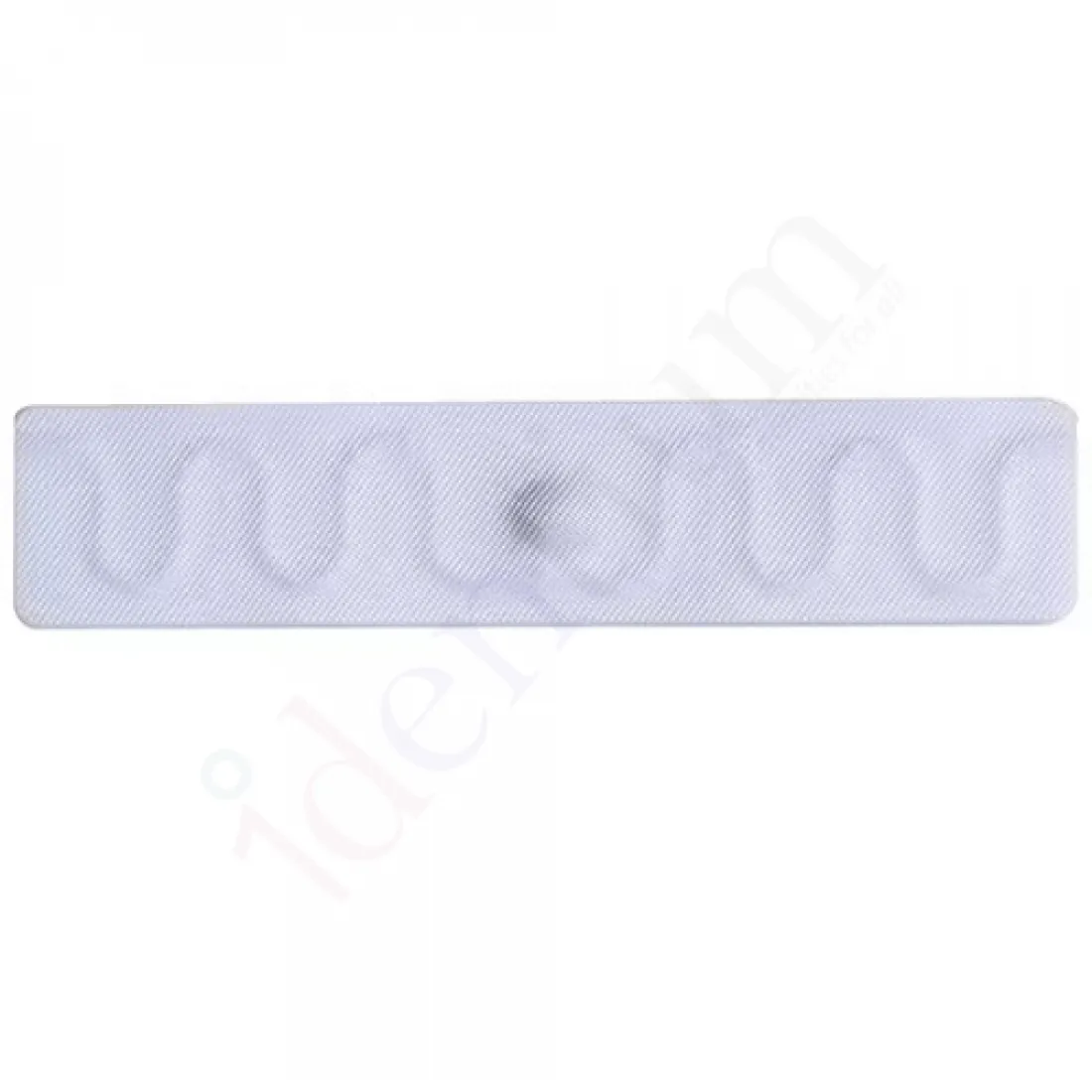
The UFLT-7515 is Identium’s woven fabric UHF RFID laundry tag for linen, garments and workwear that go through commercial wash cycles week after week. The 75 x 15 mm tag is made from heat-resistant woven polyester in a soft label format, so it sews into a collar or side seam like an ordinary care label and stays comfortable against the skin. Inside, an Impinj Monza 4QT chip gives each item a unique identity that survives more than 200 industrial washes — letting laundries and linen rooms count bundles in seconds instead of sorting and tallying by hand.
Key specifications
- Size and material: 75 x 15 mm, heat-resistant woven polyester in a woven label format
- Chip and protocol: Impinj Monza 4QT, EPC Gen 2 / ISO 18000-6C; broadband passive UHF, reads in India’s licence-exempt 865-868 MHz band
- Wash durability: 200+ cycles at 95 deg C per ISO 6330; tumble drying rated to 80 deg C; withstands commercial detergents, bleach and softeners
- Sealing: IP69K rated against water and high-pressure cleaning
- Read range: 1-4 m on the garment, supporting bag-level and trolley-level counting
- Attachment options: sewn in at collar or side seam, heat-sealed, or riveted
- Customisation: logo or customer code printing available; minimum order 200 pieces for blank tags
Applications
- Hospital linen and uniform circulation tracking
- Hotel housekeeping and linen inventory control
- Industrial workwear and Hi-Vis garment management
- Dry cleaning and textile rental billing accuracy
- Food industry uniform hygiene compliance
Specifying the UFLT-7515: what the numbers mean on your line
Bulk linen counting is a passive UHF job. EPC Gen2 — published as ISO/IEC 18000-63, branded RAIN RFID — is the only family that reads a whole bundle in one interrogation. HF at 13.56 MHz (ISO 14443/15693, NFC) and LF at 125/134 kHz read a few centimetres, which suits an item-level checkout counter where each piece passes the reader individually, not a trolley. In India the band is 865-868 MHz, set by the WPC short-range-device rules notified on 10 December 2021 as G.S.R. 853(E), which superseded the older 865-867 MHz position; confirm the rules in force with WPC before freezing a specification. One detail shapes a trolley pass: 2 W e.r.p. is permitted only on the four 200 kHz channels centred at 865.7, 866.3, 866.9 and 867.5 MHz, each limited to no more than four seconds of continuous transmission with at least 100 ms before the next burst. That duty-cycle limit means a compliant reader hops between channels rather than camping on one, so plan to reconcile a cage on a slow, deliberate pass rather than an instant snapshot.
Reading the spec sheet honestly
| The specification | What it tells you | What it does not cover |
|---|---|---|
| 200+ cycles at 95 deg C, ISO 6330 | Survival through a defined laboratory wash and dry procedure at a stated temperature | Hot calendering, pressing or dry-cleaning solvent. ISO 6330 is the domestic washing and drying procedure and ISO 15797 the industrial workwear one — they are not interchangeable, so ask any supplier which produced their figure |
| Tumble drying rated to 80 deg C | The published limit on the drying side, separate from the 95 deg C wash figure | A finishing line running hotter than that — ask us about a PPS body instead |
| IP69K sealing | Water ingress and high-pressure, high-temperature washdown | Crush, extractor spin, or needle penetration through the body |
| 1-4 m on the garment | A typical figure, not a guarantee | Damp, tightly packed loads, which read shorter and less evenly. Range is environment-dependent — prove it on your own linen |
Placement decides as much as construction does. The inlay runs inside the woven label and its antenna length is what earns the range figure, so trimming the label down to fit a narrower hem, folding it double or stitching through the body can detune the antenna and cost range before the first wash. Sewn, heat-sealed and riveted are all options on this tag — confirm the format and the stitch line with us for your actual garment rather than leaving it to the finishing floor.
Send these with an enquiry: item mix and annual volume; wash temperature and chemistry, chlorine bleach in particular; whether items pass a calender, and at what temperature; whether tags go into new purchases at manufacture or are retro-fitted into circulating stock; whether the face is printed with a customer code; and whether tags ship pre-encoded to your EPC numbering scheme. Custom tags typically run a five to ten day turnaround.
The common mistake is shortlisting on the wash-count headline alone. Two tags both claiming 200+ cycles can fail quite differently on a finishing line, and unpicking and restitching circulating linen can cost more in labour than the tags themselves — a good reason to start with new purchases and a single linen category, then widen once the read rates hold.
Related reading
- What actually drives RFID tag prices in India
- Scoping an RFID project around read range and environment
- RFID in textile and garment manufacturing, including wash-test standards
The UFLT-7515 pairs with our desktop readers for tag issue and our fixed readers for bulk reads — see the complete RFID laundry management solution for how Indian laundries deploy it end to end. Request a quote for project quantities and printed versions, or buy online at India RFID Store.
Who uses the UFLT-7515 in India
Commercial laundries, hospital linen rooms and hotel housekeeping teams searching for a washable RFID laundry tag in India typically shortlist the UFLT-7515 for one reason: it sews in like an ordinary care label yet survives 200+ industrial washes at 95 deg C. Healthcare buyers use it to track uniform and linen circulation — see our healthcare RFID solutions — while hospitality groups deploy it for housekeeping and linen inventory control. Textile rental and dry-cleaning firms pair the tag’s 1-4 m read range with fixed UHF readers for bag- and trolley-level counting that feeds straight into billing. As a New Delhi RFID tag manufacturer, Identium supplies blank tags from 200 pieces and printed versions with your logo or customer code — compare other formats on our RFID laundry tags range page before requesting a quote.