
[email protected] Product Catalog → India RFID Store

RFID Delegate Tracking — Telangana Summit 2025

When the Government of Telangana set out to host the Telangana Rising Global Summit 2025 — a flagship gathering built around the state’s ambition to become a US$3 trillion economy by 2047 — it needed far more than a venue and a guest list. Across two days (8–9 December 2025) at Bharat Future City, Hyderabad, over 2,000 high-profile attendees would move through the site: Chief Ministers, global CEOs, foreign diplomats, and public figures including PV Sindhu and SS Rajamouli. Identium Tech Solutions was brought in as the RFID technology partner to make sure every one of them reached the zones they were cleared for — and no one reached the zones they weren’t.

The challenge

A summit at this level turns access control into a live security problem:

  • Strict venue zoning. The Main Plenary Hall, VVIP lounges, media zones, and restricted food & beverage areas all had to stay cleanly separated.
  • Zero tolerance for unauthorised entry. With Cabinet Ministers and foreign delegates on site, any breach of a restricted “Red Zone” had to be detected the instant it happened.
  • Eight distinct attendee classes — Delegates, Government Officials, Service Providers, VIPs, Event Crew, Media, Police and Emergency Services — each with its own access rights.
  • No queues. You cannot ask ministers, diplomats and CEOs to stop and tap a card at every doorway. Movement had to stay fluid throughout.

The solution: Identium’s smart RFID grid

Identium deployed an end-to-end UHF passive RFID tracking and access-control system designed around free-flow movement.

  • Smart credentials. Every attendee carried an RFID-enabled badge pre-encoded with their name, category and access level — the single source of truth for where they were allowed to go.
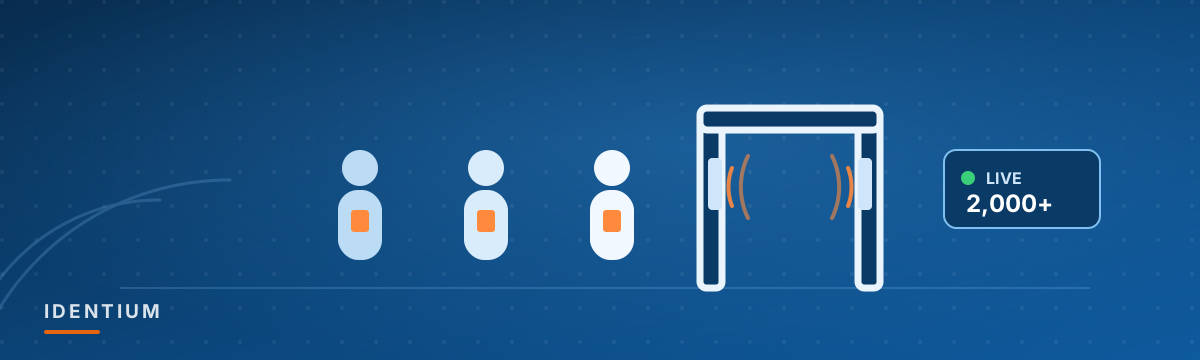
  • Gated intelligence. UHF RFID portals and fixed readers were installed at every transition point — entry gates, hall entrances and dining areas — capturing each badge on the move, with no need to stop or present a card.
  • A real-time command dashboard. A centralised web portal gave command-centre staff live visibility of who was where across the venue, turning raw badge reads into an at-a-glance operating picture.

It’s the same delegate tracking and access-management platform Identium builds for large-scale events, tuned here to summit-grade security.

Results & impact

  • 100% access compliance. Unauthorised movement into restricted zones was stopped — without creating a single bottleneck or queue.
  • Crisis-ready headcount. The system kept an accurate, real-time count available to Emergency Services, so safety decisions were backed by live data rather than guesswork.
  • Insight after the gates closed. Post-event analytics produced movement heat maps, showing organisers exactly which sessions and zones drew the heaviest footfall — intelligence they can carry straight into the next edition.

Planning an event of your own?

From two-day government summits to multi-day expos and festivals, the same RFID grid scales to the crowd size and security bar you set. Explore our delegate tracking solution, or talk to our team and we’ll map your venue, zones and attendee tiers to a working bill of materials.

Further reading

Frequently asked questions

If nobody stops to tap a card, how is access actually enforced?

Enforcement sits at the read point rather than at the door handle. Fixed and portal-style UHF readers are positioned wherever people cross from one zone into the next, and they pick up a badge as the wearer walks past — nothing to stop for, nothing to present. Each badge is encoded with the holder's category and clearance, so the read itself answers whether that person belongs on the other side, and the central dashboard puts it in front of control-room staff as it happens rather than after the fact. Read reliability depends on antenna placement and the geometry of the opening, so the layout is worked out doorway by doorway for each venue rather than assumed.

What frequency does this run on, and is the hardware cleared for use in India?

Indian UHF RFID operates in the 865–867 MHz band, and Identium's UHF readers and antennas are WPC-approved for it. The company is BIS certified and every unit is tested in-house before dispatch. Those approvals are Indian ones, so they do not travel: band allocations and approval regimes differ by country and change over time. For an event outside India, confirm the current allocation and the approvals required with that country's spectrum authority before committing to hardware. Position stated as of 2026.

Badges or wristbands — which credential suits which kind of event?

Badges suit structured, multi-tier gatherings like this summit, where eight attendee classes each carried their own encoded access rights. Wristbands tend to fit festivals and multi-day open-ground events, where the credential stays on the attendee for the duration and has to survive weather and handling. Identium makes PVC and Tyvek wristbands, from around Rs 15 a unit depending on specification and volume, alongside PVC and PETG cards in LF, HF and UHF. Artwork, printing and numbering are done in-house, so tiers can be made distinguishable to the eye as well as to the reader — which matters more the more tiers you are running.

How much lead time do event credentials need?

Custom hard tags — if the venue also needs them for equipment, vehicles or re-usable assets — typically run 5–10 days. Wristbands are quicker: Identium's stated turnaround is roughly two days for a 2,500-unit PVC or Tyvek run, with weekly capacity of around 15,000. Treat both as indicative and confirm them against your actual artwork, encoding and volume when you ask for a quote, since proofing and approval cycles usually decide the real date. Artwork, numbering, printing and encoding are handled in-house rather than subcontracted, which is what those timelines assume.

Is a setup like this only worth it at 2,000-plus attendees?

No. What drives cost and complexity is the number of transition points you need to read and the number of tiers you need to keep apart — headcount on its own matters less than either. A single-hall event with two tiers needs a small fraction of the reader count that eight tiers spread across a multi-building site does, while the software side stays broadly the same at both ends. The practical starting point is a zone-by-zone walk of the venue: the hardware list falls out of that, not out of the guest list.

Need pricing, samples or a demo?

Talk to our RFID specialists — we manufacture in India and ship nationwide.